Best by where you hunt
Best Metal Detectors for Relic Hunting: Iron Separation Over Raw Depth
Quick answer
Relic hunting rewards separation and audio, not raw depth. The Teknetics G2+ at $299.00 gives you adjustable iron audio on an 11 inch DD coil. The Nokta The Legend Pro Pack Pro Pack ships with 6 inch and 11 inch coils and several frequencies. Small coils matter more than the machine.
An old site is not short of targets. It is full of them, and almost all of them are iron: nails, wire, strapping, horseshoes, bits of stove. The machine that wins on ground like that is the one that can tell you there is a good target sitting eight inches from a nail, not the one that claims another inch of depth in clean soil.
So the specifications worth reading are recovery speed, iron audio and coil options, and the one accessory that changes results most is a small coil. Everything below is arranged by budget, but it is worth saying at the top that a mid-priced machine with the right coil will out-hunt a flagship with the wrong one. The coil size chart sets out that trade in detail, and the coils page lists what fits what.
Top pick

Nokta The Legend Pro Pack
The Pro Pack ships with both the 6 inch and 11 inch DD coils, so the small-coil answer to iron is already in the box, alongside two multi-frequency profiles and single frequencies from 4 to 40 kHz.
Price was accurate when this page was compiled and changes often.
On this page
- What makes a relic machine different from a coin machine?
- Beginner: buy the audio, not the badge
- Intermediate: a proven machine and the small coil that transforms it
- Expert: weight, speed and total coil freedom
- How do the relic machines compare?
- Why does the coil matter more than the machine on an old site?
- What digging tool does an old site actually need?
What makes a relic machine different from a coin machine?
Three things: how fast it recovers between targets, how much it tells you about iron rather than hiding it, and whether you can put a small coil on it. A park machine is tuned to give you a clean number on an isolated coin in mild soil. A relic machine has to stay honest when a good target is masked by a nail lying across it.
Iron audio is the feature that earns its keep. The Garrett AT Pro publishes 40 levels of iron discrimination along with proportional audio and tone roll, which is Garrett saying plainly that the audio carries more information than the number does. The Teknetics G2+ publishes FeTone adjustable iron audio, which lets you turn iron down without turning it off, plus V-Break so you can move the tone breakpoints yourself. Turning iron off entirely is how people walk over good targets, so both of these exist for the same reason.
Mineralisation is the other half of the problem. Old ground is often hot ground, and a higher operating frequency copes better with small low-conductor targets in it. The Garrett AT Gold runs at 18 kHz with a ground balance window, and the Fisher Gold Bug Pro runs 19 kHz with a real-time mineralisation readout. Both are sold as gold machines and both are used as relic machines for exactly that reason. The frequency chart explains where the trade-off turns against you.
Beginner: buy the audio, not the badge
The mistake at this level is spending the whole budget on the machine and nothing on the tool that gets the target out of the ground. Old sites are full of roots, and a garden trowel will bend inside a month. The Teknetics G2+ at $299.00 is here because it gives you adjustable iron audio and a real 11 inch DD coil at a price where most machines give you neither, on a body that weighs just over two pounds.
Be honest with yourself about ground first. If the site you have permission for is a clean pasture rather than a demolished farmhouse, you do not need any of this and a general-purpose machine will serve you better.

Teknetics G2+
$299.00FeTone adjustable iron audio, V-Break variable tone breakpoints, computerised ground balancing and an 11 inch DD open elliptical coil, at $299.00 on a body just over two pounds.
Best for: iron-heavy ground on a first budget
Check price on Amazon
Lesche Sampson Pro-Series T-Handle Shovel, 31 inch
$89.40Lesche publishes 31 inches overall, a 7.5 by 4 inch serrated and pre-sharpened blade and a weight of 2 lb 6 oz, hand made in the USA, at $89.40. The T-handle is what lets you put weight behind it in hard ground.
Best for: cutting through roots and compacted soil
Check price on Amazon
Serious Detecting Gloves (large)
$13.95Padded palm, touchscreen thumb, index and middle fingers, and a hook-and-loop closure at $13.95. Rusted metal and broken glass are what actually come out of an old house site.
Best for: anyone digging on demolition ground
Check price on AmazonIntermediate: a proven machine and the small coil that transforms it
This is where most serious relic hunters sit, and the reason is the coil ecosystem rather than the machines themselves. The Garrett AT Pro at $459.99 has been in the field long enough that there is a coil for every situation, including the Garrett 5 by 8 DD PROformance Coil sniper coil and the NEL Hunter 12.5 by 8.5 Coil for AT Pro for open ground. The Fisher F75 at $419.00 takes the other approach: Fisher sells it on weight and ergonomics, with double-filter discrimination modes for trashy ground and a magnetic mineralisation bar graph so you can see what the soil is doing to you.
Buy the small coil at the same time as the machine. It is the single change that makes the most difference on a site that has already been hunted.

Garrett AT Pro
$459.99Proportional audio and tone roll, 40 levels of high-resolution iron discrimination, fast recovery and submersible to 10 feet, at $459.99. The coil support is the real argument: almost every aftermarket maker cuts one for it.
Best for: mixed sites where you also cross streams and wet ground
Check price on Amazon
Fisher F75
$419.00Double-filter discrimination for trashy areas, a magnetic mineralisation bar graph and readout, trigger-actuated FastGrab ground balance and a 0 to 99 display, at $419.00. Fisher sells it on ergonomics, which matters on a ten hour day.
Best for: long days on old sites full of iron
Check price on Amazon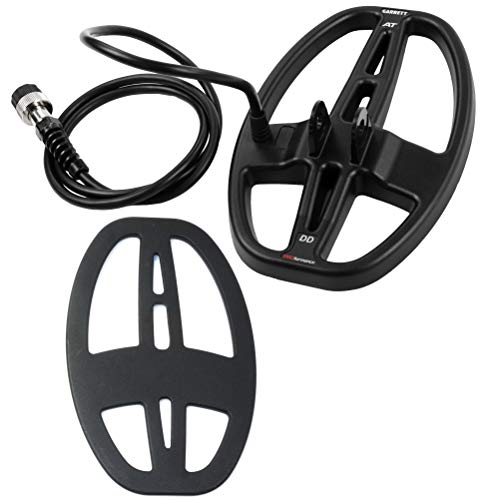
Garrett 5 by 8 DD PROformance Coil
$164.95A 5 by 8 inch DD sniper coil at $164.95. A big coil sees a nail and a button as one blurred signal; this one works between them. It fits the whole Garrett AT series.
Best for: working between nails on a demolished building
Check price on AmazonExpert: weight, speed and total coil freedom
The XP Deus II at $1,299.00 is here for two reasons. It is fully wireless from coil to headphones, which on a long day is a real physical difference, and XP publishes 12 fast simultaneous multi-frequency programs plus 49 single frequencies from 4 to 45 kHz, which means you can tune to the ground rather than choosing a mode and hoping. It is also IP68 rated to 66 feet, the deepest published figure in this catalog.
The Nokta The Legend Pro Pack Pro Pack is the value answer at this level. Nokta ships it with both the 6 inch and 11 inch DD coils, so the thing that usually costs another $127.99 is already included, and it runs two multi-frequency profiles plus 4, 10, 15, 20 and 40 kHz singles.

XP Deus II
$1,299.00Fully wireless from coil to headphones, 12 fast simultaneous multi-frequency programs, 49 single frequencies from 4 to 45 kHz and an IP68 rating to 66 feet, at $1,299.00. XP publishes a five year warranty on it.
Best for: all-day hunting and total tuning control
Check price on Amazon Nokta The Legend Pro Pack
$659.00The Pro Pack includes the 6 inch and 11 inch DD coils, two simultaneous multi-frequency profiles and singles at 4, 10, 15, 20 and 40 kHz, at $659.00. Two coils in the box is what makes it the value pick.
Best for: someone who wants the small coil included
Check price on Amazon
Garrett AT Gold
$640.99Garrett publishes 18 kHz operation, true all metal mode, iron audio and a manual and automatic ground balance window, submersible to 10 feet, at $640.99. The ground balance window is the feature that matters in mineralised soil.
Best for: heavily mineralised sites and small targets
Check price on Amazon
Lesche T-Handle Shovel, 36 inch double serrated
$99.80Lesche publishes 36 inches overall with a 29 inch shaft, a double serrated 7.3 by 4 inch blade and a weight of 2 lb 9 oz, at $99.80. The extra five inches over the Sampson 31 is a back-saver if you are tall.
Best for: tall users digging all day
Check price on AmazonWho should not buy this tier: None of this belongs on a first machine. The XP Deus II has a menu deep enough that a beginner will never leave the factory programs, and if you are going to do that you have spent $1,299.00 for no gain over a $459.99 machine. The Garrett AT Gold is the wrong buy for anyone hunting mild soil or salt beaches, because its higher frequency is tuned for small targets in hot ground and gives you nothing on a clean park. And if your permission is a single suburban lawn, a 36 inch T-handle shovel is not a tool, it is a problem: cut small plugs with a hand digger instead and keep the permission.
How do the relic machines compare?
Read the coil column first. A machine with no small coil available is a machine that cannot work an iron-infested site, whatever else it does.
Every machine here has a genuinely small coil available, and the Nokta Legend Pro Pack is the only one in this catalog that includes a 6 inch coil in the box rather than selling it separately.
| Machine | Iron handling as published | Small coil option | Price |
|---|---|---|---|
| Teknetics G2+ | FeTone adjustable iron audio, V-Break | Stock 11 inch DD only in this catalog | $299.00 |
| Garrett AT Pro | 40 levels of iron discrimination, tone roll | 5 by 8 DD at $164.95 | $459.99 |
| Fisher F75 | Double-filter discrimination, mineralisation graph | Double-D waterproof coil as supplied | $419.00 |
| Garrett AT Gold | Iron audio, ground balance window, 18 kHz | 5 by 8 DD fits the AT series | $640.99 |
| Nokta The Legend | Multi-frequency profiles plus 4 to 40 kHz singles | 6 inch LG15 included in the Pro Pack | $659.00 |
| XP Deus II | 12 multi-frequency programs, 49 singles | XP coil range, sold separately | $1,299.00 |
| Minelab Equinox 900 | 119 high-resolution target IDs | EQX 06 included with the 900 | $999.00 |
Figures are taken from each manufacturer listing or manual. Coil availability reflects what is in this catalog, not every coil ever made for these machines.
Why does the coil matter more than the machine on an old site?
Because masking is the whole problem. A large coil generates a wide detection field, and when a nail and a button sit inside that field at the same time the machine averages them and reports iron. A smaller coil sees a smaller patch of ground, so it can resolve the two separately. That is the entire mechanism, and it is why people who hunt worked sites carry two coils.
The practical options are a genuinely small round coil or a narrow ellipse. The Minelab EQX 06 Coil (6 inch) at $225.00 is the 6 inch Double-D for the Equinox series and the X-Terra Pro, and Minelab publishes its weight at 10.68 oz with the skidplate fitted. The Nokta LG15 Coil (6 inch) at $127.99 does the same job on The Legend. The Coiltek 10 by 5 NOX Search Coil at $308.00 is the compromise: a 10 by 5 ellipse keeps a long sweep footprint while staying narrow enough to work between iron, which means you lose less coverage than a 6 inch round costs you.
You pay for this in ground covered per hour. A 6 inch coil on a big field is slow enough to be demoralising. Use the coil size selector to sanity check the choice against the site in front of you, and the coverage calculator to see what the smaller coil costs you in hours.
What digging tool does an old site actually need?
Roots. That is the answer. On a demolished house site or a woodland edge the resistance is not soil, it is root mat and buried rubble, and a plain trowel will not cut either. Serrated edges are what the detecting-specific tools have that garden tools do not. Lesche publishes a serrated, pre-sharpened blade on the Lesche Sampson Pro-Series T-Handle Shovel, 31 inch and a double serrated blade on the Lesche T-Handle Shovel, 36 inch double serrated, and both are built around a T-handle you can lean on.
Hand diggers still matter for the shallow targets and for anywhere you must keep the hole small. The Lesche Digging Tool and Sod Cutter with sheath at $59.95 comes with a belt sheath, which is worth having because the blade is genuinely sharp, and the CKG Double Serrated Hand Digger at $29.99 is a double serrated budget version at about half the price. Add a pinpointer and you stop enlarging holes to find something you have already located: the Minelab PRO-FIND 35 at $99.00 publishes ferrous tone ID, which on an iron site saves a dig on its own.
Whatever you carry, the hole is your reputation. Cut a plug, keep it intact, put it back and tread it down. Permission on good ground is far harder to replace than any tool on this page.
How we chose
We did not test any of this in person and no find on this site is presented as ours. Specifications come from each manufacturer listing or manual and are attributed where they appear. Picks were chosen for the things that decide an iron-heavy site: adjustable iron audio, fast recovery, the availability of a genuinely small coil, and a digging tool that can cut a clean plug through roots.
Sources
- Garrett AT Pro and AT Gold product listings
- Fisher F75 product listing
- Teknetics G2+ product listing
- Nokta The Legend Pro Pack product listing
- XP Deus II product listing
- Lesche Sampson and T-Handle shovel product listings
Frequently asked questions
What makes a relic machine different from a coin machine?
Recovery speed, iron audio and coil options. A coin machine is tuned to give a clean number on an isolated target in mild soil. A relic machine has to stay honest when a good target is masked by a nail, which means telling you about iron rather than hiding it. That is why the AT Pro publishes 40 levels of iron discrimination and the Teknetics G2+ publishes adjustable iron audio.
Do I really need a small coil for relic hunting?
On a site that has already been hunted, yes, and it will do more for your results than a more expensive machine will. A large coil averages a nail and a good target into one signal. A 6 inch coil such as the Minelab EQX 06 Coil (6 inch) or the Nokta LG15 Coil (6 inch) resolves them separately. The cost is coverage: a small coil takes far longer to walk a field, so most people carry both.
Is a higher frequency better in mineralised soil?
Higher frequencies are more sensitive to small and low-conductivity targets, which is why the AT Gold runs 18 kHz and the Gold Bug Pro runs 19 kHz, and why both get used on hot relic ground. The trade is that higher frequencies lose ground on large high-conductor targets such as big silver, and they pick up more mineralisation noise if you do not ground balance properly.
What length of shovel should I buy?
Match it to your height and to the permission. Lesche publishes 31 inches on the Lesche Sampson Pro-Series T-Handle Shovel, 31 inch and 36 inches on the Lesche T-Handle Shovel, 36 inch double serrated, and taller diggers generally find the 36 inch saves their back over a full day. On lawns and tidy permissions leave the shovel in the car entirely and cut small plugs with a hand digger, because the size of your holes decides whether you are invited back.
How deep do relics actually sit?
Deeper than coins on the same site, because ploughing, demolition and decades of leaf litter bury them further, but any single number is meaningless without a target size, a coil and a soil condition attached to it. Treat published depth claims as ranges under ideal conditions. The depth chart sets out what actually moves the figure.
Researched, not professional advice. This page is compiled from published specifications, manuals and owner-review consensus, not hands-on testing. Target ID numbers, depth figures and settings vary with soil chemistry, moisture, target size, depth, orientation and firmware version, so treat every figure here as a starting point and verify it against your own machine's manual and your own ground. As an Amazon Associate we earn from qualifying purchases.