Best detectors
Best Metal Detector for Kids: Why the Cheapest One Is Often the Wrong Gift
Quick answer
The Garrett ACE 200 at $149.99 is the best metal detector for most children over about eight, because it is a real machine with a 0 to 99 target ID that finds things. Under that age the Bounty Hunter Junior at $49.00 is genuinely designed for children, at a published 5 inch depth on coins.
There is a hard truth at the bottom of this category. The very cheap detectors sold as children's toys are limited machines, and the limitation that matters is depth. National Geographic publishes a 4 inch detection depth for its starter kit and Bounty Hunter publishes 5 inches for coins on the Junior. In a typical lawn, most of what is findable at that depth is recent loose change and bottle caps, which means a lot of digging and very little treasure.
Children are not put off by a detector being simple. They are put off by finding nothing. That is the whole argument of this page: a slightly better machine, with a real target ID and a bigger coil, is usually the kinder purchase, because the child finds an old coin in the first month rather than a handful of nails. It is also the purchase that survives a second child. Pair whatever you buy with the coin find value calculator, which turns a jar of finds into a number and is more motivating than any feature on a box.
Top pick

Garrett ACE 200
A real detector at a child-friendly price: Garrett publishes a 0 to 99 digital target ID, a 6.5 by 9 waterproof coil, a weight under 3 lb and a 3-year warranty, which is a machine that keeps finding things as the child improves.
Price was accurate when this page was compiled and changes often.
On this page
What actually makes a detector work for a child?
Weight first. National Geographic publishes 1.2 pounds for its starter kit, and that number is why a five year old can use it. Garrett publishes under 3 pounds for the Garrett ACE 200, which is fine for most children of eight or nine with an adjustable stem and a strap. An adult flagship at 2.8 pounds sounds similar and is not, because balance and length both work against a short arm.
After weight, the ability to find something. That means a coil of reasonable size and a published depth that is not four inches. And after that, feedback the child can read: a target strength meter or a numeric target ID, which turns every signal into a small prediction the child gets to check by digging. Bounty Hunter publishes a built-in speaker and a target strength meter on the Bounty Hunter Junior with volume that rises as you close in, which is exactly the right mechanic for a young child.
Which detector suits which age?
Age bands here are a judgement from published weights and control complexity, not a manufacturer specification, except where a maker states one. Depth claims are quoted exactly as published.
Published depth claims for children’s machines run from 4 inches on the National Geographic starter kit to 5 inches on coins for the Bounty Hunter Junior, which is why a real entry-level machine finds noticeably more.
| Machine | Price | Published weight or coil | Published depth claim | Realistic age band |
|---|---|---|---|---|
| Bounty Hunter Junior | $49.00 | Adjustable length, designed for ages 6 and up | Coins to 5 in, larger objects to 3 ft | About 6 to 9 |
| National Geographic Starter Kit | $49.99 | 1.2 lb, 7.4 in dual coil waterproof to 4 in | Objects up to 4 in | About 5 to 9, and the lightest here |
| Garrett ACE 200 | $149.99 | Under 3 lb, 6.5 by 9 in waterproof coil | Not published as a depth figure | About 8 and up |
| National Geographic PRO Series | $159.95 | 10 in waterproof coil, collapsible | As deep as 12 in | About 9 and up, pinpointer included |
| Minelab GO-FIND 44 | $218.99 | 10 in 7.8 kHz waterproof coil, folds for travel | Not published in this listing | About 8 and up, and good for travel |
| Garrett ACE 300 | $269.99 | 0 to 99 target ID with iron resolution | Not published as a depth figure | A committed child of about 11 and up |
| Minelab Vanquish 340 | $258.99 | 10 by 7 waterproof coil, Multi-IQ | Not published as a depth figure | A teenager who is serious about it |
Depth claims are quoted verbatim from the maker listings and are made on the maker’s own terms. Age bands are our judgement from published weight and control complexity. No machine here has been used by us.
What should you buy for a young child?
Something light, cheap and forgiving, and go in with clear eyes about what it will find. National Geographic Starter Metal Detector Kit at $49.99 is published at 1.2 pounds with a 7.4 inch dual coil waterproof to 4 inches, LED and audio alerts, an adjustable arm, a heavy-duty trowel and a colour learning guide. Bounty Hunter Junior at $49.00 is designed for ages 6 and up with a target strength meter and a discrimination control. Both are honest products at honest prices, and both are shallow.

National Geographic Starter Metal Detector Kit
$49.99Published at 1.2 lb with a 7.4 inch dual coil waterproof to 4 inches, LED and audio alerts, an adjustable arm and comfort grip, plus a heavy-duty trowel and a full-colour learning guide. The published detection depth is 4 inches, so expect recent drops rather than old coins.
Best for: children of about five to nine, and holidays at the beach
Check price on Amazon
Bounty Hunter Junior
$49.00Bounty Hunter designs it for ages 6 and up with an adjustable length, a built-in speaker and a target strength meter whose volume rises as the child closes in, plus a discrimination control to ignore nails. Published at 5 inches on coins and up to 3 feet on larger objects.
Best for: a first detector for a child aged roughly six to nine
Check price on Amazon
Minelab GO-FIND 44
$218.99Minelab publishes a 10 inch 7.8 kHz waterproof coil, two camouflage skins and a carry bag, on a body that folds down small and weighs very little. The 10 inch coil is a real coil rather than a toy one, which is what lifts it above the price-equivalent starter kits.
Best for: family trips and smaller users who need a light machine
Check price on AmazonWhat is the kinder purchase for a child who is genuinely interested?
A real entry-level detector, and this is the recommendation this page exists to make. Garrett ACE 200 at $149.99 gives a child a 0 to 99 digital target ID, sharp audio, a 6.5 by 9 inch waterproof PROformance searchcoil, a weight under 3 pounds and a 3-year warranty, made in the USA. It finds old coins in ground where a 4 inch machine finds a bottle cap, and the target ID number turns every dig into a little experiment. National Geographic PRO Series Metal Detector and Pinpointer Set is the alternative if you want a pinpointer in the same box.
Garrett ACE 200
$149.99A 0 to 99 digital target ID with sharp audio, a 6.5 by 9 inch waterproof PROformance concentric searchcoil, an adjustable stem and ergonomic grip, under 3 lb, made in the USA with a 3-year warranty. Garrett notes that the control box is not waterproof even though the coil is.
Best for: a child of about eight and up who has asked more than once
Check price on Amazon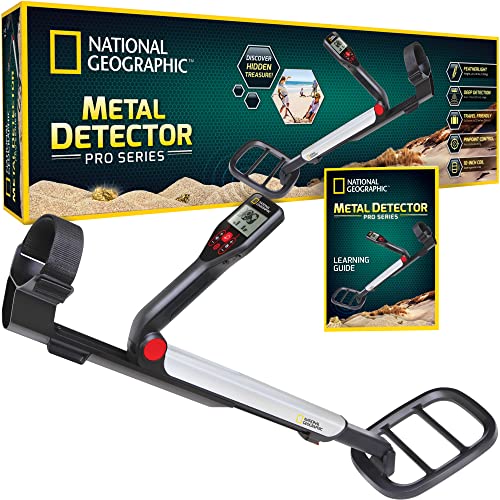
National Geographic PRO Series Metal Detector and Pinpointer Set
$159.95Bundles a detector with a pinpointer, which is the accessory that most shortens the learning curve for anyone and especially for a child who lacks the patience to widen a hole. Published with a 10 inch waterproof coil, an LCD display, 4 sensitivity levels, 3 detection modes and a claim of up to 12 inches.
Best for: an older child, or a parent buying one kit for both of you
Check price on Amazon
Garrett ACE 300
$269.99Adds iron resolution for better separation of good targets from iron trash, electronic pinpointing in a non-motion all-metal mode, and an adjustable frequency that tunes out interference in a park full of other detectors and power lines.
Best for: a committed child of about eleven and up
Check price on AmazonWhen should a teenager get an adult machine?
When they have used a simpler machine for a season and asked for more. At that point Minelab Vanquish 340 at $258.99 brings simultaneous multi-frequency, which opens up beaches, and Nokta Simplex Ultra at $299.00 is fully waterproof to 16 feet at 2.6 pounds on a carbon fibre shaft, which is lighter than several machines marketed to children. A teenager who is hunting with a club or with a parent will not be held back by either.

Minelab Vanquish 340
$258.99Multi-IQ simultaneous multi-frequency with a 10 by 7 waterproof DD coil and three modes for coin, jewellery and relic, on AA cells with a carry bag included. Multi-frequency is what makes a beach holiday productive rather than an exercise in falsing.
Best for: a teenager who has already put in a season
Check price on Amazon
Nokta Simplex Ultra
$299.00Fully waterproof to 16 ft on a carbon fibre shaft retracting to 25 inches, at 2.6 lb. Nokta states that Bluetooth headphones are not included. The light build and short packed length make it genuinely practical for a smaller person.
Best for: a teenager who wants to hunt water as well as land
Check price on Amazon
Minelab Equinox 700
$749.00Multi-IQ plus four single frequencies, full waterproofing to 16 ft, 2.8 lb on carbon fibre shafts and low latency wireless headphones included. This is a serious adult machine and it will not be outgrown, which is the only argument for it at this age.
Best for: a teenager who detects most weekends and intends to keep going
Check price on AmazonWho should not buy this tier: Do not buy this tier as a surprise gift. A machine at this price is only the right choice for a child who has already used a simpler one and asked for more, and buying it first removes the learning stage that makes the hobby stick. Do not buy a heavy adult machine on the theory that a child will grow into it: an unswingable detector gets used twice and then lives in a cupboard. And do not buy any detector at all for a child who has nowhere to use it. Permission matters as much for an eleven year old as for an adult, and a detector with no ground to hunt is the most expensive ornament in the house.
What else does a child need?
Gloves, first. Broken glass and rusted metal are what actually comes out of old ground, and Serious Detecting Gloves (large) cost less than a takeaway. A small pouch such as the Waterproof Mesh Waist Pouch stops finds going into pockets and through the wash. A Illuminated 30x and 60x Jewellers Loupe at $8.99 is the accessory that turns a jar of dirty coins into a hobby, because dates and mint marks are invisible to the naked eye and finding a readable date is the moment most children get hooked.
Add a pinpointer once the child is digging regularly. A Minelab PRO-FIND 15 at $69.00 is the cheapest sensible one and removes the main source of frustration, which is a target that will not appear. The pinpointer roundup explains why, and the digger roundup covers hand tools, which are the only kind a child should be using on turf.
How we chose
No child of ours has tested these and we are not going to invent an anecdote about one. Depth claims, weights and coil sizes are quoted from each manufacturer's own published listing, named in the sources. The ranking weights three things that decide whether a child keeps detecting: published depth capability, because finding nothing ends the hobby; weight, because an adult machine is unswingable for a small person; and simplicity of controls. Where a maker publishes an age range we have used it, and where one does not we have said so rather than inventing a band.
Sources
- Bounty Hunter Junior product listing and owner manual
- National Geographic Starter Kit and PRO Series product listings
- Garrett ACE 200 and ACE 300 owner manuals
- Minelab GO-FIND 44 owner manual
- Minelab Vanquish 340 product specifications
Frequently asked questions
What is the best metal detector for a child?
The Garrett ACE 200 at $149.99 for most children over about eight, because it is a genuine detector with a 0 to 99 target ID and a 6.5 by 9 inch waterproof coil, weighing under 3 pounds. For younger children the Bounty Hunter Junior at $49.00 is designed for ages 6 and up and publishes 5 inches on coins, which is honest about what it does.
Are cheap toy metal detectors worth buying?
They work, within their published limits, and those limits are shallow. National Geographic publishes 4 inches for its starter kit, which means a child will mostly find recent loose change and bottle caps. If the goal is an afternoon at the beach, that is fine. If the goal is a child who stays interested, a real entry-level machine finds more and holds attention far longer.
What age can a child start metal detecting?
Around five or six with a light machine and an adult doing the digging. Bounty Hunter designs the Junior for ages 6 and up, and National Geographic publishes 1.2 pounds for its starter kit, which a small child can carry. The limiting factor is usually patience rather than strength, so short sessions on ground that actually produces something matter more than the specification.
Should I buy my child a pinpointer?
Yes, once they are digging regularly. The commonest reason a child gives up mid-hole is that the target refuses to appear, and a pinpointer turns that into a few seconds of work. The Minelab PRO-FIND 15 at $69.00 is the cheapest sensible option, is fully waterproof to 5 feet and has a lost alarm, which matters when a child puts it down in long grass.
Can children use an adult metal detector?
An older child often can, if the machine is light and the stem adjusts short enough. The Nokta Simplex Ultra is published at 2.6 pounds and retracts to 25 inches, which is more manageable for a smaller person than several detectors marketed at children. What does not work is handing a child a heavy flagship to grow into, because the balance and length defeat a short arm.
Researched, not professional advice. This page is compiled from published specifications, manuals and owner-review consensus, not hands-on testing. Target ID numbers, depth figures and settings vary with soil chemistry, moisture, target size, depth, orientation and firmware version, so treat every figure here as a starting point and verify it against your own machine's manual and your own ground. As an Amazon Associate we earn from qualifying purchases.