Cross-machine master charts
Metal Detector Frequency Chart: Which kHz Finds Silver, Gold and Relics
Quick answer
Low frequencies, roughly 4 to 8 kHz, favour high conductors such as silver and copper coins. High frequencies, 30 kHz and above, favour small gold and other low conductors. Between 10 and 20 kHz is the general-purpose band most coin and relic machines run. Simultaneous multi-frequency machines cover several bands at once.
Operating frequency is the number of times per second the coil energises the ground, quoted in kilohertz. It decides which targets the machine is most sensitive to, and it is the single specification that separates a coin machine from a gold machine. A 5 kHz coil and a 45 kHz coil swept over the same ground find different things, and neither is better in the abstract.
The short version: low frequency for big high-conductive targets, high frequency for small low-conductive ones. The longer version, which is the one that saves you money, is that simultaneous multi-frequency machines transmit several frequencies at once and process the returns together, which is why the Minelab Equinox 900 covers park, field, beach and gold from one body. If you are choosing between machines rather than settings, the weight comparison and the roundups are the pages to read alongside this one.
Top pick
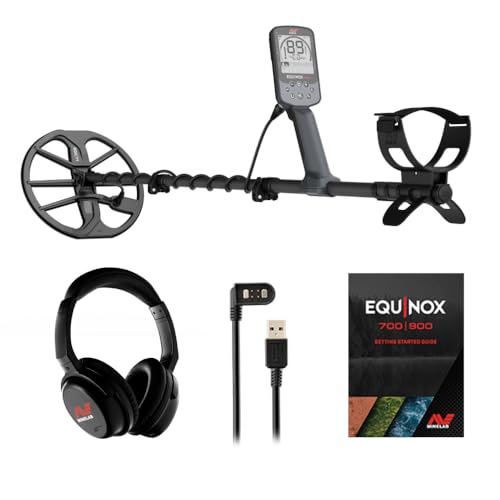
Minelab Equinox 900
Minelab publishes six single frequencies plus Multi-IQ on the 900, which covers the whole chart below from one machine.
Price was accurate when this page was compiled and changes often.
What does each frequency band find best?
Read this as a bias rather than a boundary. A 5 kHz machine still finds gold and a 45 kHz machine still finds quarters. The frequency decides which one it hears first when both are in the ground.
Frequencies below about 8 kHz favour silver and copper coins, 10 to 20 kHz is the all-round coin and relic band, and 30 kHz and above is where small gold starts to give a usable signal.
| Frequency band | Strongest on | Weakest on | Who runs it |
|---|---|---|---|
| 4 to 5 kHz | Silver and copper coins, large high conductors | Small gold, thin foil, tiny jewellery | Coin shooters on old parks and pasture |
| 5 to 8 kHz | Clad and silver coins, deep high conductors | Small gold, small lead | General coin hunting in mild soil |
| 9 to 15 kHz | All-round coins, rings, mid-size relics | Nothing badly, which is why it is the default | Most general-purpose single-frequency machines |
| 15 to 25 kHz | Small jewellery, small relics, mineralised ground | The deepest high conductors | Relic hunters and jewellery hunters |
| 25 to 45 kHz | Small gold, thin chains, fine jewellery | Large silver, deep coins | Prospectors and beach jewellery hunters |
| 45 kHz and above | The smallest gold nuggets | Coins of any kind, and stability in trash | Dedicated prospecting only |
| Simultaneous multi-frequency | Several bands at once, including wet salt sand | Nothing specific, at a higher purchase price | Anyone who hunts more than one type of site |
Frequency bias is a property of the physics. The specific machines listed for each band come from the manufacturer listings summarised in the next table.
What frequencies do current machines actually run?
Every figure below is published by the maker. Where a listing does not publish a figure, the row says so rather than guessing.
Published single frequencies in this catalog run from 4 kHz on the Nokta Legend up to 71 kHz on the Fisher Gold Bug 2, a spread of nearly twenty to one.
| Machine | Published frequencies | Multi-frequency? | Best suited to |
|---|---|---|---|
| Minelab Equinox 900 | 6 single frequencies plus Multi-IQ, 5 at once | Yes | Park, field, beach and gold from one machine |
| Minelab Equinox 700 | 4 single frequencies plus Multi-IQ, 5 at once | Yes | Park, field and beach |
| Minelab Manticore | Multi-IQ+, published as 50 percent more power | Yes | Depth in mineralised ground |
| Minelab X-Terra Elite | Multi-IQ | Yes | Waterproof multi-frequency on a budget |
| Minelab X-Terra Pro | Switchable single frequencies (PRO-SWITCH) | No | A fully waterproof single-frequency machine |
| Minelab Vanquish 540 | Multi-IQ, 5 frequencies at once | Yes | A first multi-frequency machine |
| Nokta The Legend | 4, 10, 15, 20 and 40 kHz plus two multi profiles | Yes | The widest single-frequency spread for the money |
| Garrett ACE Apex | 5, 10, 15 and 20 kHz, Multi-Frequency, Multi-Salt | Yes | Garrett users wanting multi-frequency |
| Garrett Vortex VX9 | 5, 9, 13, 18 and 25 kHz plus multi | Yes | Garrett owners stepping up from the AT line |
| Garrett Vortex VX5 | 13 kHz or MD-MF multi mode | Yes | The entry point to the Vortex platform |
| Garrett AT Max | 13.6 kHz | No | All-terrain coin and relic hunting |
| Garrett AT Gold | 18 kHz | No | Small gold and mineralised relic ground |
| Fisher Gold Bug Pro | 19 kHz | No | Small gold on a lower budget |
| Minelab Gold Monster 1000 | 45 kHz VLF | No | Small gold with automatic setup |
| Garrett Goldmaster 24k | 48 kHz | No | Fine gold in known goldfields |
| Fisher Gold Bug 2 | 71 kHz | No | The smallest gold, and little else |
| XP Deus II | 49 single frequencies from 4 to 45 kHz, 12 multi programs | Yes | Anyone who wants every option in one wireless body |
| Minelab Excalibur II | BBS, 1.5 to 25.5 kHz | Yes | Salt water diving and surf |
| Minelab GO-FIND 44 | 7.8 kHz coil | No | Travel and family use |
Figures are taken from each maker listing or manual. The Manticore listing does not publish single-frequency values, so none are printed here.
Does a higher frequency go deeper?
No, and this is the most persistent myth in the hobby. Lower frequencies penetrate ground slightly better on large high-conductive targets, which is why coin shooters historically ran low. Higher frequencies excite small low-conductive targets more strongly, which is why gold machines run high. Depth on any given target is set far more by coil size, soil mineralisation and target size than by frequency, which is what the coil size chart exists to show.
Soil mineralisation is the complication. Highly mineralised ground absorbs signal, and it absorbs more of a high frequency than a low one. That is why a 45 kHz prospecting machine can feel shallow in red clay and why the manufacturers of high-frequency machines such as Fisher Gold Bug 2 put so much emphasis on ground balance controls.
When is a single frequency still the right choice?
When you hunt one kind of site and you want the money in the build rather than in the electronics. Minelab X-Terra Pro is fully waterproof to 16 feet at a price where most machines are splash-resistant, and it gets there by switching between single frequencies instead of running several at once. Garrett AT Gold at 18 kHz is still a serious choice for mineralised relic ground. A dedicated prospecting frequency such as the 71 kHz on Fisher Gold Bug 2 will out-hear any multi-frequency machine on the smallest gold.
Where single frequency genuinely loses is wet salt sand, where the salt itself is conductive and a single frequency cannot separate the salt response from the target response. That is the case multi-frequency was invented for, and it is why the beach sections of the Equinox 900 settings guide look the way they do. If you are building a first kit around one machine, the beginner setup lists what goes with it.
Sources
- Minelab Equinox 700 and 900 instruction manual
- Minelab Gold Monster 1000 instruction manual
- Garrett Vortex VX9 and ACE Apex product specifications
- Fisher Gold Bug 2 owner manual
- XP Deus II product specifications
Frequently asked questions
What frequency is best for silver coins?
Low, in the region of 4 to 8 kHz, because silver is a high conductor and low frequencies favour high conductors. On a multi-frequency machine you do not usually need to pick one: the multi profile weights the low end appropriately for coins. If your machine offers single frequencies and you are working a site that produces silver, dropping to the lowest available frequency is a reasonable experiment to run against your own test garden.
What frequency do I need for small gold?
High. Small gold is a poor conductor with very little mass, so it needs a high frequency to respond at all. Dedicated prospecting machines sit at 45 kHz for the Gold Monster 1000, 48 kHz for the Goldmaster 24k and 71 kHz for the Gold Bug 2. A general machine running 15 to 20 kHz will find larger nuggets and most jewellery, but it will walk past the smallest pieces.
Is simultaneous multi-frequency worth the extra money?
It is if you hunt more than one kind of site, and especially if one of them is a salt water beach. Running several frequencies at once lets the machine separate the salt response from the target response, which single frequency cannot do well. If you only ever hunt dry inland parks, a good single-frequency machine will find the same coins for less money.
Can I change the frequency on my machine to find more gold?
Only within the range your machine publishes. Switching an Equinox to its highest single frequency genuinely improves its response to small gold, and that is why the Gold modes exist. It will not turn a coin machine into a prospecting machine, because the coil, the processing and the ground balance range all matter as much as the number. Check your manual for the frequencies your model actually offers.
Does frequency affect how deep I can detect?
Less than people assume. Lower frequencies hold a small advantage on large high-conductive targets and higher frequencies lose more signal in mineralised soil, but coil diameter, target size and ground conditions dominate the result. If depth is what you are chasing, a larger coil and better ground balance will do far more for you than changing the frequency by a few kilohertz.
Researched, not professional advice. This page is compiled from published specifications, manuals and owner-review consensus, not hands-on testing. Target ID numbers, depth figures and settings vary with soil chemistry, moisture, target size, depth, orientation and firmware version, so treat every figure here as a starting point and verify it against your own machine's manual and your own ground. As an Amazon Associate we earn from qualifying purchases.