Gold machines
Minelab Gold Monster 1000 vs Garrett Goldmaster 24k: Which Gold Machine?
Quick answer
The Gold Monster 1000 at $899.00 runs 45 kHz with fully automatic ground balance, noise cancel and sensitivity, and a 5 inch waterproof coil. The Goldmaster 24k at $679.99 publishes a single 48 kHz frequency and little else. Buy the Monster if you are new to prospecting.

Minelab Gold Monster 1000
$899.0045 kHz VLF with a 24-bit processor, fully automatic ground balance, noise cancel and sensitivity, gold chance indicator, 5 inch waterproof coil.
Best for: small gold with the least possible setup
Check price on Amazon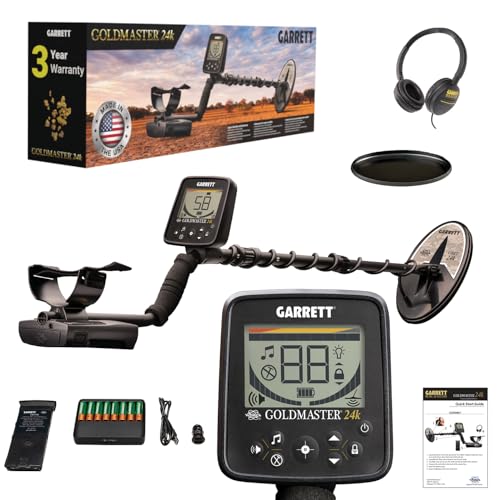
Garrett Goldmaster 24k
$679.99A single high operating frequency of 48 kHz, which is where very small gold gives a usable signal and a coin machine gives almost none.
Best for: fine gold in known goldfields
Check price on AmazonBuy Minelab Gold Monster 1000 if you are new to prospecting, because Minelab automates the three settings that beginners get wrong. Minelab publishes a 45 kHz VLF with a 24-bit signal processor, fully automatic noise cancelling, ground balance and sensitivity, a gold chance indicator, gold and deep all-metal modes, and a 5 inch coil waterproof to 3 feet.
Garrett Goldmaster 24k at $679.99 is the cheaper machine and publishes a single high operating frequency of 48 kHz in our catalog and very little beyond it. That is not a criticism of the detector, it is a statement about the record: we will not rank a machine on specifications its listing does not carry. If you are choosing between these two on detail rather than on price, the Goldmaster 24k settings chart and the Gold Monster 1000 settings chart are where the published operating detail lives.
Top pick
Minelab Gold Monster 1000
45 kHz with fully automatic ground balance, noise cancel and sensitivity, a gold chance indicator, and a 5 inch coil waterproof to 3 feet.
Price was accurate when this page was compiled and changes often.
On this page
Why does 45 or 48 kHz matter for gold?
Because small gold is a poor conductor and a low-frequency machine barely notices it. Detection response rises with frequency for small, low-conductivity targets, which is why prospecting machines live between roughly 19 and 71 kHz while coin machines sit far lower. At 45 and 48 kHz respectively these two are both squarely in nugget territory, and the 3 kHz between them is not a meaningful difference.
The same physics is why a high-frequency machine is a liability on a coin site. High frequencies are noisier in mineralised ground, they read large silver less confidently, and they light up on every scrap of foil and every tiny wire. If somebody sells you a gold machine as an all-rounder, they are wrong, and the frequency chart shows exactly where the trade sits.
How do the published specifications compare?
This is the least symmetrical table on the site, and the asymmetry is the finding rather than a flaw in the comparison.
Minelab publishes a 5 inch coil and fully automatic ground balance for the Gold Monster, and the Garrett listing publishes a 48 kHz single high frequency and nothing else in this catalog.
| Model | Price | Operating frequency | Frequency type | Stock coil | Ground balance |
|---|---|---|---|---|---|
| Minelab Gold Monster 1000 | $899.00 | - | - | 5 in | Fully automatic |
| Garrett Goldmaster 24k | $679.99 | 48 kHz | Single high frequency | - | - |
Figures are taken from each manufacturer's own published listing and specification sheet. A dash means the maker does not publish that figure for that model, not that the feature is absent.
Where does the published record run out?
Six of these rows are blank on the Garrett side. Read that as a gap in the listing, not as a missing feature, and go to the manual before deciding.
Minelab publishes the frequency, processor, automation, coil, modes and water rating for the Gold Monster, while the Garrett listing in this catalog publishes only the 48 kHz single high frequency.
| Specification | Minelab Gold Monster 1000 | Garrett Goldmaster 24k |
|---|---|---|
| Price | $899.00 | $679.99 |
| Operating frequency | 45 kHz VLF | 48 kHz, single high frequency |
| Signal processing | 24-bit signal processor | Not published in this listing |
| Ground balance | Fully automatic | Not published in this listing |
| Noise cancel | Automatic | Not published in this listing |
| Sensitivity | Automatic, with manual options | Not published in this listing |
| Coil supplied | 5 in, waterproof to 3 ft | Not published in this listing |
| Modes | Gold with iron reject, and deep all metal | Not published in this listing |
| Target aid | Gold chance indicator | Not published in this listing |
| Headphones | Not included | Not published in this listing |
From the Minelab and Garrett product listings. The blank rows mean the Garrett listing in our catalog does not carry those figures, and the current Goldmaster 24k manual is the place to confirm them. We do not estimate specifications.
Choose the Gold Monster 1000 if
You are new to prospecting, or you want to spend your time covering ground rather than tuning. Automatic ground balance is the feature that matters here: goldfields are mineralised almost by definition, hot rocks are everywhere, and a badly balanced machine is a machine screaming at dirt. Minelab automating that is the single most beginner friendly decision in this category.
Choose it too for the 5 inch coil, which is the right size for picking small nuggets out of ground rather than covering acres, and for the 3 foot coil waterproofing that lets you work a creek bed. The Gold Monster review covers the machine alone, and how to ground balance explains what the automation is doing for you, which is worth knowing even when you do not have to do it.
Choose the Goldmaster 24k if
You want the higher frequency for the least money, and you are willing to read the manual and confirm the specification yourself. At $679.99 it is considerably cheaper than the Gold Monster, and 48 kHz is the higher of the two published frequencies, which favours the smallest gold.
Choose it too if you already prospect and want manual control rather than automation. Experienced prospectors frequently prefer to set ground balance and threshold themselves, because they can hear ground conditions changing before a machine reacts. We will not claim which controls the 24k gives you, because the listing does not publish them, so confirm that in the Garrett manual before buying on that basis. The gold roundup sets both against the rest of the category.
What else does prospecting require?
Ground, first. Gold is where gold has been found before, and prospecting on ground with no history is a hobby rather than a strategy. Beyond that you need recovery kit that coin hunting does not: ASR Outdoor Gold Pan Beginners Kit, 5 piece, SE Stackable Classifier, 1/8 inch mesh for sizing material, Garrett Gold Guzzler Snuffer Bottle for picking fine gold out of a pan, and Gold Collection Glass Vials, 12 pack to put it in.
A scale matters too, because a nugget you cannot weigh is a nugget you cannot value. Digital Pocket Scale, 200 g by 0.01 g reads to 0.01 g, which is fine resolution for anything these machines will find, and the gold nugget value calculator converts that weight to a melt value at your own purity assumption and spot price. Remember that natural gold is rarely pure, so assume a fineness rather than a number and treat the result as a range.
Sources
- Minelab Gold Monster 1000 product listing and specifications
- Minelab Gold Monster 1000 instruction manual
- Garrett Goldmaster 24k product listing
- Garrett Goldmaster 24k owner manual
Frequently asked questions
Which of these detects smaller gold?
On published frequency alone the Goldmaster 24k sits slightly higher at 48 kHz against 45 kHz for the Gold Monster, and higher frequency favours smaller gold. That 3 kHz gap is small enough that coil size, ground balance and operator patience will matter far more. Neither maker publishes a smallest detectable nugget size, so nobody can answer this with a weight.
Can I use a gold detector for coin hunting?
You can, and you will not enjoy it. High frequencies are noisy in mineralised soil, respond strongly to foil and small wire, and read large silver less confidently than a coin machine does. If you want one detector for both jobs, buy a simultaneous multi-frequency machine with a gold mode rather than a dedicated high-frequency prospecting detector.
Why does the comparison table have so many blanks for the Goldmaster?
Because the Garrett listing in our catalog publishes only the operating frequency and frequency type for that machine, and we do not print specifications we cannot source. A blank row means the figure is not in the listing, not that the feature is absent. The current Goldmaster 24k owner manual is the document that settles those rows.
Is automatic ground balance a disadvantage for an expert?
Some experienced prospectors prefer manual control, because they can hear ground changing and respond before an automatic system does, and because manual balancing lets you deliberately offset to handle hot rocks. For anyone in their first seasons the automation is a clear benefit, since a badly balanced machine in mineralised ground finds nothing at all.
Researched, not professional advice. This page is compiled from published specifications, manuals and owner-review consensus, not hands-on testing. Target ID numbers, depth figures and settings vary with soil chemistry, moisture, target size, depth, orientation and firmware version, so treat every figure here as a starting point and verify it against your own machine's manual and your own ground. As an Amazon Associate we earn from qualifying purchases.