Gold prospecting
Fisher Gold Bug 2 vs Minelab Gold Monster 1000: Manual Control or Full Automation?
Quick answer
The Fisher Gold Bug 2 at $739.00 runs 71 kHz with manual 16-turn ground balance and two coils. The Gold Monster 1000 at $899.00 runs 45 kHz but is fully automatic for ground balance, noise cancelling and sensitivity. The lower-frequency automatic machine costs more than the higher-frequency manual one.
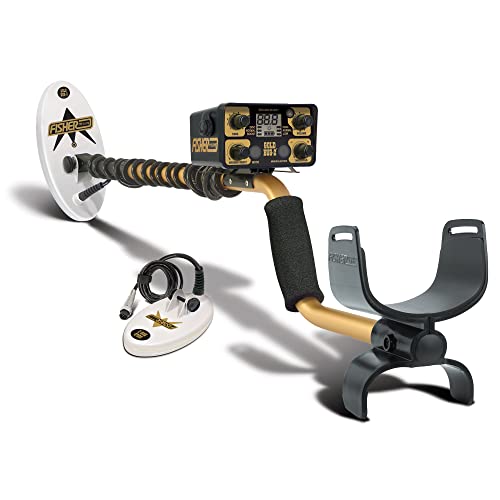
Fisher Gold Bug 2
$739.0071 kHz ultra-high frequency, manual 16-turn ground balance, 3-position mineralization switch, 6 in and 10 in waterproof elliptical coils, 2.9 lb.
Best for: the smallest gold, where almost nothing else responds
Check price on Amazon
Minelab Gold Monster 1000
$899.0045 kHz VLF with a 24-bit signal processor, fully automatic ground balance, noise cancelling and sensitivity, 5 in waterproof coil, touchpad gold chance indicator.
Best for: small gold with the least possible setup
Check price on AmazonThis pairing inverts the usual rule that more capability costs more money. Fisher Gold Bug 2 publishes an industry-leading 71 kHz operating frequency, a manual 16-turn ground balance control, a three-position mineralization switch, 6 inch and 10 inch waterproof elliptical coils and iron discrimination, for $739.00. The Gold Monster 1000 publishes a lower 45 kHz frequency paired with a 24-bit signal processor, fully automatic noise cancelling, ground balance and sensitivity, a touchpad interface with a gold chance indicator, and a 5 inch waterproof coil, for $899.00.
So the machine with the higher, theoretically more gold-sensitive frequency costs less, and the machine that does the tuning for you costs more. That is not a contradiction, it is the price of automation versus the price of raw sensitivity that requires skill to use. The frequency chart explains why 71 kHz responds to smaller gold than 45 kHz does, all else being equal.
Top pick
Minelab Gold Monster 1000
Fully automatic ground balance, noise cancelling and sensitivity at 45 kHz, with a touchpad gold chance indicator that removes the setup a manual machine demands.
Price was accurate when this page was compiled and changes often.
On this page
Why does the cheaper machine run the higher frequency?
Because frequency and automation are two separate engineering problems, and Fisher and Minelab solved different ones. Fisher publishes the Gold Bug 2's 71 kHz as industry-leading for detecting small and deep gold nuggets, but that sensitivity comes with a manual 16-turn ground balance control and a mineralization switch you have to set correctly for your soil. Get that setup wrong and a 71 kHz machine can chatter constantly in hot, mineralised ground.
Minelab instead spent its engineering budget on the Gold Monster's 24-bit signal processor and full automation: automatic noise cancelling, automatic ground balance and automatic sensitivity, all running at a more moderate 45 kHz. Garrett describes a similar trade at 48 kHz with its Goldmaster 24k, which sits between these two on both frequency and price. The result is that the Gold Monster is genuinely easier to get right on the first outing, and Minelab charges for that ease rather than for raw frequency.
How do the published specifications compare?
Fisher and Minelab publish differently here, one around frequency and manual control, the other around automation and signal processing.
Fisher publishes a 71 kHz frequency and manual ground balance for the Gold Bug 2, and Minelab publishes a 45 kHz frequency with full automation and a 24-bit signal processor for the Gold Monster 1000.
| Model | Price | Frequency type | Stock coil | Ground balance |
|---|---|---|---|---|
| Fisher Gold Bug 2 | $739.00 | Single ultra-high frequency | 6 and 10 | - |
| Minelab Gold Monster 1000 | $899.00 | - | 5 in | Fully automatic |
Figures are taken from each manufacturer's own published listing and specification sheet. A dash means the maker does not publish that figure for that model, not that the feature is absent.
Where does the published record actually differ?
Eight rows, and each machine wins on the axis it was built for rather than one machine sweeping the table.
The Gold Bug 2 publishes the higher 71 kHz frequency, two coils and manual control for less money, while the Gold Monster 1000 publishes full automation, a 24-bit processor and a gold chance indicator for more.
| Specification | Fisher Gold Bug 2 | Minelab Gold Monster 1000 |
|---|---|---|
| Price | $739.00 | $899.00 |
| Frequency | 71 kHz, single ultra-high | 45 kHz VLF with 24-bit signal processor |
| Ground balance | Manual, 16-turn control | Fully automatic |
| Coils | 6 in and 10 in elliptical, both waterproof | 5 in, waterproof to 3 ft |
| Mineralization control | 3-position switch | Automatic |
| Interface | Manual threshold and gain controls | Touchpad with gold chance indicator |
| Discrimination | Iron discrimination mode | Gold, iron reject and deep all-metal modes |
| Weight | 2.9 lb | Not published in this listing |
From the Fisher and Minelab listings for both machines. Neither is a coin machine, and both are built specifically for small gold rather than for general park or beach detecting.
Choose the Gold Bug 2 if
You already know how to run a manual ground balance and want the highest published frequency in this catalog for chasing the smallest gold in the toughest, most mineralised ground. Two coils, a 6 inch elliptical for tight spots and a 10 inch for coverage, come in the box, and the 3-position mineralization switch gives an experienced prospector a level of control full automation removes.
Choose it too if you also intend to use it as a relic detector, since Fisher publishes the Gold Bug 2 as effective on mineralised relic ground, not only on pure gold prospecting. The best metal detector for gold roundup covers where it sits against the rest of the field.
Choose the Gold Monster 1000 if
You are new to gold prospecting and want a machine that removes the setup steps a manual detector demands. Minelab's own language, that it "turns beginners into professionals," is a fair description of what full automatic ground balance, noise cancelling and sensitivity actually does for someone who has never tuned a VLF gold machine before. Read the Gold Monster 1000 settings chart and the full review before your first outing.
Choose it too if the touchpad gold chance indicator and simplified mode structure matter more to you than raw frequency, since 45 kHz combined with a 24-bit processor is still a genuinely capable gold-sensitive frequency, just not the highest one published in this catalog.
What matters more than the choice between these two?
Ground research. Gold does not distribute evenly, and no frequency or automation level substitutes for prospecting in a documented goldfield. ASR Outdoor Gold Pan Beginners Kit, 5 piece and SE Stackable Classifier, 1/8 inch mesh are the cheap first step for confirming an area actually carries colour before you spend a season swinging either detector there.
The gold nugget weight to value calculator is worth bookmarking for whatever either machine eventually turns up, and the ground balance guide explains the manual process the Gold Bug 2 asks you to run yourself.
Sources
- Fisher Gold Bug 2 product listing and specifications
- Minelab Gold Monster 1000 product listing and specifications
- Garrett Goldmaster 24k product listing, for frequency context
Frequently asked questions
Is 71 kHz always better than 45 kHz for gold?
Higher frequencies are generally more sensitive to the smallest, lowest-conductivity gold, so on paper the Gold Bug 2's 71 kHz has an edge for the tiniest nuggets. In practice, correctly tuned automatic ground balance on the Gold Monster can outperform a poorly set manual balance on the Gold Bug 2, so operator skill matters as much as the published frequency number.
Can a complete beginner use the Fisher Gold Bug 2?
Yes, but expect a learning curve around the manual 16-turn ground balance and the mineralization switch, both of which need to be set correctly for your soil before the machine performs well. Fisher's own materials treat these as adjustable expert controls rather than automatic conveniences, which is exactly why the Gold Monster exists as an alternative.
Which machine is better for coins and jewelry, not gold?
Neither is built for that job. Both run frequencies and interfaces optimised for small, low-conductive gold targets rather than the broader identification a coin-hunting machine like the Equinox or Legend provides. If general detecting is the main use, choose from this catalog's coin and relic machines instead and treat either gold detector as a second, specialised purchase.
Does the Gold Monster's smaller coil limit it on open ground?
A 5 inch coil covers less ground per sweep than the Gold Bug 2's 10 inch option, which does mean slower coverage of large areas. Minelab's trade-off is that a smaller coil is also more sensitive to the tiny nuggets the Gold Monster targets, so the size is a deliberate choice for the job rather than a limitation to work around.
Researched, not professional advice. This page is compiled from published specifications, manuals and owner-review consensus, not hands-on testing. Target ID numbers, depth figures and settings vary with soil chemistry, moisture, target size, depth, orientation and firmware version, so treat every figure here as a starting point and verify it against your own machine's manual and your own ground. As an Amazon Associate we earn from qualifying purchases.