Best supporting kit
Best Wireless Headphones for Metal Detecting: Latency Is the Whole Story
Quick answer
Ordinary Bluetooth headphones add enough delay to make pinpointing by ear impossible, so a detector needs a low-latency set. The Minelab ML105 Wireless Headphones at $180.00 covers the Manticore, Equinox 700 and 900 and X-Terra Pro. Wireless never works under water.
Detecting audio is not music. It is a stream of information you use to judge depth, size and the shape of a signal as the coil passes over it, and the timing of that stream against the movement of your arm is the information. Ordinary Bluetooth introduces a delay measured in the low hundreds of milliseconds, which is imperceptible when watching a film and completely destroys pinpointing by ear.
That is why detector makers sell their own headphones instead of telling you to use the ones you already own, and why the specification to look for is low latency rather than sound quality. Minelab describes the ML 80 and ML105 as low latency built for detectors. Garrett publishes Z-Lynk as six times faster than Bluetooth. XP publishes its own radio protocol as ten times faster than Bluetooth low latency. Those claims are about timing, not about fidelity, and timing is the whole story. The other thing to know before you spend anything: none of it works under water, which is covered on the underwater machines page.
Top pick

Minelab ML105 Wireless Headphones
Minelab publishes low-latency wireless for the Manticore, Equinox 700 and 900 and X-Terra Pro from one pair, with a detachable 3.5 mm AUX cord to convert them to wired, plus a USB-C charging cable, at $180.00.
Price was accurate when this page was compiled and changes often.
On this page
- Why will ordinary Bluetooth headphones not work?
- Beginner: the matched sets, and the wired pair worth owning anyway
- Intermediate: one pair that covers several machines
- Expert: the aftermarket sets, and the ones that go under water
- Which headphones work with which machine?
- What else should you look for besides latency?
Why will ordinary Bluetooth headphones not work?
Because of latency. Standard Bluetooth audio buffers the signal before playing it, which introduces a delay you never notice with music because nothing in the room depends on the timing. In detecting everything depends on the timing: you judge a target by where in the sweep the tone rises and falls, and you pinpoint by moving the coil until the signal peaks. Add a couple of hundred milliseconds and the peak arrives after the coil has already passed the target.
Every wireless system sold for detecting is an answer to that one problem. Minelab publishes the ML105 as using enhanced super-fast low-latency technology for minimal time delay and faster detection response. Garrett publishes Z-Lynk as six times faster than Bluetooth. Nokta sells a Bluetooth low-latency set specifically for The Legend. XP goes furthest, publishing its own patented radio protocol at ten times faster than Bluetooth low latency on the XP Deus II.
The practical consequence is that headphones are not generic. A set built for one brand's protocol will usually not pair with another brand's machine, and the compatibility line in the listing is the specification that decides your purchase. If you want to understand what the audio is telling you in the first place, the signal reading guide and the Equinox 900 tone profiles are the useful background.
Beginner: the matched sets, and the wired pair worth owning anyway
If your machine has a wireless protocol, buy the set its maker built for it. That is not brand loyalty, it is the only reliable way to get a pairing that works and stays paired. The two wireless picks here are the least expensive matched sets in this catalog.
The third pick is wired and it is here deliberately. A cheap wired pair lives in the bag, cannot run out of battery, and is what saves a day when the wireless set is flat or refuses to pair. Garrett publishes a quarter inch right-angle plug, volume control and a 10 foot coiled cable on the Garrett MS-2 Headphones for $33.99.
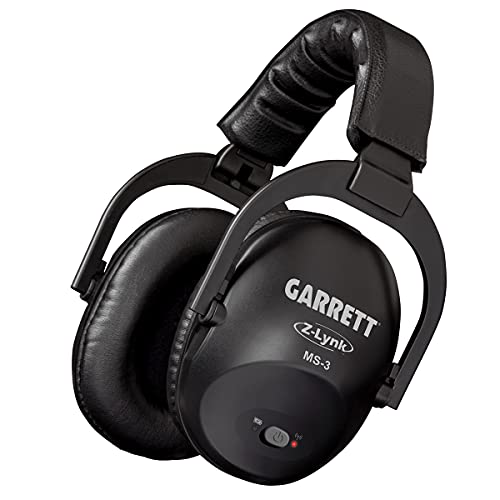
Garrett MS-3 Z-Lynk Wireless Headphones
$107.99Garrett publishes a built-in Z-Lynk receiver, volume control to lift weak signals, foldable storage and a 30 to 18,000 Hz frequency response, at $107.99. Z-Lynk also pairs with the Garrett Pro-Pointer AT Z-Lynk, so the pinpointer audio arrives in the same cups.
Best for: AT Max owners and anyone running Z-Lynk
Check price on Amazon
Nokta Bluetooth Low Latency Headphones for The Legend
$110.99Nokta publishes Bluetooth low latency compatibility with The Legend, at $110.99. Buying the matched set removes the pairing question entirely, which on a machine with firmware updates is worth more than a small saving elsewhere.
Best for: Nokta Legend owners
Check price on Amazon
Garrett MS-2 Headphones
$33.99Garrett publishes a quarter inch right-angle stereo plug, a volume control for lifting weak signals, a reinforced 10 foot coiled cable and 8 ohm speakers, at $33.99. Wired headphones cannot go flat, which is the entire argument for keeping a pair in the bag.
Best for: a backup pair that always works
Check price on AmazonIntermediate: one pair that covers several machines
The interesting option at this level is a set that covers more than one machine, because most people who stay in the hobby end up owning two detectors rather than one. Minelab publishes the Minelab ML105 Wireless Headphones as compatible with the Manticore, the Equinox 700 and 900 and the X-Terra Pro from a single pair, and it converts to wired with the supplied AUX cable.
The other problem this tier solves is an older machine with no wireless at all. Nokta sells a 2.4 GHz set with its own transmitter, which plugs into the headphone socket of a machine that has never heard of Bluetooth and makes it wireless.
Minelab ML105 Wireless Headphones
$180.00Minelab publishes compatibility with the Manticore, Equinox 700 and 900 and X-Terra Pro, enhanced low-latency technology for minimal delay, and a detachable 3.5 mm AUX cord plus USB-C charging cable so they convert to wired, at $180.00.
Best for: owners of more than one current Minelab
Check price on Amazon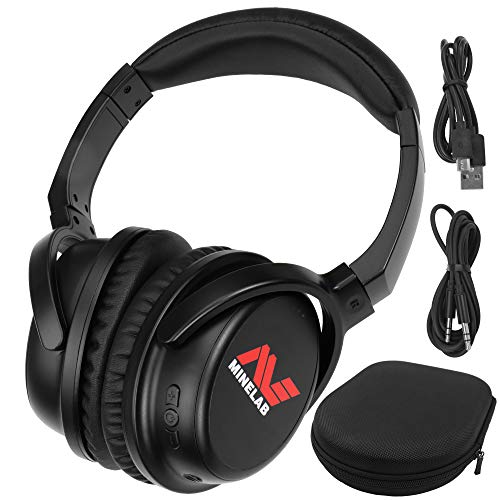
Minelab ML 80 Wireless Headphones
$150.00Minelab publishes compatibility with the Equinox 600 and 800, supplied with a carrying case, a 3.5 mm AUX cable and a charging cable, at $150.00. Low-latency Bluetooth built for detectors, which is a different product from the Bluetooth headphones you already own.
Best for: Equinox 600 and 800 owners
Check price on Amazon
Nokta 2.4 GHz Wireless Headphones, Green Edition
$118.99A 2.4 GHz set supplied with its own transmitter, at $118.99, so it works with machines that have no Bluetooth at all. Nokta also publishes it as compatible with the Nokta PulseDive Pinpointer, which has a wireless module built in.
Best for: older machines and PulseDive owners
Check price on AmazonExpert: the aftermarket sets, and the ones that go under water
Serious audio people go wired, and they go to DetectorPro. The Gray Ghost sets are built around hearing faint deep signals rather than around music, and the specification that matters is the muff: DetectorPro publishes sound-blocking muffs that eliminate ambient noise up to 24 decibels, which on a windy field or a surf line is the difference between hearing a marginal target and not.
The other half of this tier is the wet sets. Wireless does not work under water at all, so a submersible machine needs a sealed wired pair, and those are machine specific. The underwater machines page pairs each set to its machine.

Gray Ghost Original Platinum Headphones
$129.95DetectorPro publishes Platinum speakers made in the USA, sound-blocking muffs that cut ambient noise up to 24 decibels, heavy polymer full-ear muffs, a heavy-duty coiled cable with a 90 degree quarter inch connector, and a selector switch for compatibility with single-output detectors, at $129.95.
Best for: chasing faint deep targets in wind
Check price on Amazon
Gray Ghost Amphibian Headphones for Minelab
$169.95DetectorPro publishes waterproofing to 200 feet, solid-state speakers designed for wet or dry conditions, 24 decibels of ambient reduction, and a muff-to-muff cable on a padded headband with no screws or wire frame to rust, at $169.95.
Best for: Manticore and Equinox owners who go under water
Check price on Amazon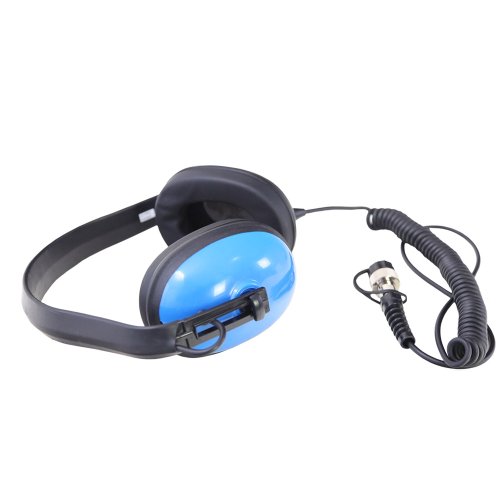
Garrett Submersible Headphones
$149.99Garrett\u2019s wired submersible set for the AT series, at $149.99. The AT bodies are rated to 10 feet and the Vortex bodies to 16, and neither can use wireless once the control box is under, so this is the part that makes the rating usable.
Best for: submerging a Garrett AT or Vortex machine
Check price on AmazonWho should not buy this tier: Do not buy the Gray Ghost Original Platinum Headphones if your machine has no quarter inch socket or you intend to stay wireless, because you will be adding an adapter to a cable you did not want. Do not buy a submersible set at all unless you actually put the control box under water: standing in ankle-deep water is not submerging a machine, and the ML105 at $180.00 will serve you better on land. And nobody with one detector needs a multi-machine set, so the cheaper matched pair is the right buy until the second machine arrives.
Which headphones work with which machine?
Read the compatibility column and stop there. A wireless set built for one brand's protocol will generally not pair with another brand's machine, whatever the connector looks like.
Every wireless set here uses a low-latency protocol built for detectors rather than standard Bluetooth, and none of the wireless sets function once the control box is under water.
| Headphones | Price | Wireless or wired | Published compatibility |
|---|---|---|---|
| Garrett MS-2 | $33.99 | Wired, quarter inch plug | Any detector with a quarter inch socket |
| Garrett MS-3 Z-Lynk | $107.99 | Wireless, Z-Lynk | Z-Lynk machines and Z-Lynk pinpointers |
| Gray Ghost Original | $109.95 | Wired | Aftermarket, single-output detectors |
| Nokta Bluetooth for The Legend | $110.99 | Wireless, Bluetooth low latency | Nokta The Legend |
| Nokta 2.4 GHz Green Edition | $118.99 | Wireless, 2.4 GHz with transmitter | Machines without Bluetooth, and PulseDive |
| Minelab ML85 | $125.00 | Wireless, low latency | Minelab Manticore |
| Gray Ghost Platinum | $129.95 | Wired, 90 degree quarter inch | Single-output detectors, selector switch |
| Garrett Submersible | $149.99 | Wired, submersible | Garrett AT series under water |
| Minelab ML 80 | $150.00 | Wireless, low latency Bluetooth | Equinox 600 and 800 |
| Thresher Submersible | $157.99 | Wired, over 100 ft rating | Nokta Simplex and Legend under water |
| Gray Ghost Amphibian | $169.95 | Wired, 200 ft rating | Minelab Manticore and Equinox |
| Minelab Equinox Waterproof | $170.00 | Wired, waterproof | Minelab Equinox series under water |
| Minelab ML105 | $180.00 | Wireless, converts to wired | Manticore, Equinox 700 and 900, X-Terra Pro |
Compatibility is as published in each manufacturer listing. Several listings in this catalog carry copy that plainly belongs to another product, and nothing from those bullets has been quoted here. Check the maker page for your exact model before buying.
What else should you look for besides latency?
Isolation, weight and controls, in that order. Isolation is the underrated one: a sealed muff blocks wind, road noise and surf, all of which sit right on top of the faint signals you are straining for. DetectorPro publishes 24 decibels of ambient reduction on its muff design, and that figure does as much for your deep-target hit rate as any setting on the machine.
A volume control on the cup matters more than it sounds, because it lets you lift a weak signal without going into the detector's menu mid-swing. Garrett publishes one on both the Garrett MS-2 Headphones and the Garrett MS-3 Z-Lynk Wireless Headphones. Weight and clamping force decide whether you are still wearing them in hour four, and a foldable set survives being thrown into a bag, which is what actually happens to them.
Finally, check what the machine already includes before you buy anything. Minelab publishes low-latency wireless headphones as included with both the Minelab Equinox 700 and the Minelab Equinox 900, and Bluetooth headphones with the Minelab Vanquish 540 Pro-Pack. Nokta states plainly that Bluetooth headphones are not included with the Nokta Simplex Ultra. Garrett includes the MS-2 with the Garrett AT Pro and the MS-3 with the Garrett AT Max. That is a hundred dollar swing between otherwise similar purchases, and it is easy to miss when comparing machine prices on the under $500 page.
How we chose
We did not test any of these headphones in person and no latency figure here is something we measured. Compatibility, wireless protocol and included accessories are taken from each manufacturer listing and stated as such. Where a product listing in this catalog carries obviously incorrect copy carried over from another item, we have not quoted it. Picks were chosen on published machine compatibility first and price second.
Sources
- Minelab ML105, ML 80 and ML85 product listings
- Garrett MS-3 Z-Lynk, MS-2 and Submersible headphone product listings
- Nokta Bluetooth low latency and 2.4 GHz Green Edition product listings
- DetectorPro Gray Ghost Platinum, Original and Amphibian product listings
- XP Deus II product listing, for its published wireless protocol
Frequently asked questions
Can I use my existing Bluetooth headphones with a metal detector?
Usually they will pair and the result will be unusable. Standard Bluetooth buffers audio, which adds a delay of a few hundred milliseconds, and pinpointing by ear depends on the tone peaking at the moment the coil passes the target. The low-latency sets that detector makers sell exist entirely to solve that, which is why Garrett publishes Z-Lynk as six times faster than Bluetooth.
Do wireless headphones work under water?
No, and no manufacturer claims they do. Radio at 2.4 GHz is absorbed by water within inches, so the link drops as soon as the control box goes under. A submerged machine needs a physically wired sealed set such as the Minelab Equinox Waterproof Headphones, the Garrett Submersible Headphones or the Thresher Submersible Headphones for Nokta, and that is a separate purchase on most machines.
Are expensive headphones actually better for detecting?
Not for fidelity, which is irrelevant here. What the money buys is isolation and durability. DetectorPro publishes muffs that cut ambient noise by up to 24 decibels, which matters enormously in wind or surf where the faintest signals are the ones you are chasing. A set that folds and survives a bag is the other half of the value.
Do headphones from one brand work with another brand of detector?
Wired ones generally do, provided the plug matches, which is why the quarter inch Garrett MS-2 Headphones is a useful universal spare. Wireless ones generally do not, because each maker uses its own low-latency protocol. The exception is a set supplied with its own transmitter, such as the Nokta 2.4 GHz Wireless Headphones, Green Edition, which plugs into any machine with a headphone socket.
Should I use headphones at all, or the built-in speaker?
Headphones, almost always. A speaker loses the quietest signals to wind and traffic, and those quiet signals are the deep ones. Headphones also keep your hunting to yourself in a public park, which is worth more goodwill than it sounds. Keep one ear cup slightly off if you are somewhere you need to hear traffic or livestock.
Researched, not professional advice. This page is compiled from published specifications, manuals and owner-review consensus, not hands-on testing. Target ID numbers, depth figures and settings vary with soil chemistry, moisture, target size, depth, orientation and firmware version, so treat every figure here as a starting point and verify it against your own machine's manual and your own ground. As an Amazon Associate we earn from qualifying purchases.