Best detectors
Best Sand Scoop for Metal Detecting: Stainless, Titanium and What to Skip
Quick answer
A sand scoop is a perforated basket on a handle that lets sand fall out while the target stays in. CKG 304 Stainless Sand Scoop at $89.99 is the sensible buy for most beach hunters. Spend $32.99 on a GADFISH first if you are only trying beach detecting once.
On a beach the digging tool decides your hunt rate, not the detector. Sand collapses into the hole as fast as you open it, so the recovery method that works inland, cut a plug and lift it, does not exist here. Instead you push a basket through the sand, lift, and shake until only the target is left. Do that forty times in a tide and the difference between a good scoop and a bad one is the difference between going home tired and going home early.
Three things separate them and none of them is brand. Hole size decides what falls through, handle length decides whether you bend for every target, and material decides whether the scoop survives salt. Everything else is marketing. If you are still choosing the machine that goes with it, the beach detector roundup covers that, and the saltwater guide explains why wet salt sand is the hardest ground most people ever swing over.
Top pick

CKG 304 Stainless Sand Scoop
CKG publishes the same basket design as its flagship scoops in 304 stainless at about half the price, with a shark tooth sifting edge, which is the point where a beach scoop stops being a compromise.
Price was accurate when this page was compiled and changes often.
On this page
- What actually makes one sand scoop better than another?
- How do the main scoops compare on what the makers publish?
- What should a first sand scoop cost?
- What does a hundred dollars buy on a beach?
- When is a two hundred dollar scoop justified?
- How do you actually recover a target in sand without losing it?
What actually makes one sand scoop better than another?
Hole size first. Sand drains through a large hole faster, which is what you want, but a hole large enough to pass a thin gold chain or a small hammered coin will pass your find straight back into the beach. The GADFISH Stainless Sand Scoop listing publishes 8.5 mm hexagonal holes, which is a reasonable compromise and a useful number to compare others against. If you hunt for jewellery specifically, err smaller and accept the extra shake, because the targets you are chasing are the ones most likely to escape. The jewellery roundup covers the machines that find them in the first place.
Handle length second, and this is the one most people get wrong. A short scoop means bending at the waist for every single target, and on a beach you will dig far more targets per hour than you do inland because there is no discrimination penalty for a quick check. RTG publishes a fixed 28 inch handle on its 33 inch dry sand scoop and a 47 inch handle on the Pro water scoop, and that difference is entirely about whether you are standing upright or reaching down through water.
Material third. Salt water eats mild steel, and a scoop that spends its life wet will be a rusted ornament inside two seasons. Stainless resists it, and titanium resists it almost completely, which is the whole argument for the price of a titanium scoop. Carbon fibre appears only in handles, where the job is weight rather than corrosion, and the CKG Carbon Fiber Sand Scoop Handle exists precisely to rescue a heavy scoop you already own.
How do the main scoops compare on what the makers publish?
Only figures each maker prints are shown. Several listings are silent on weight or hole size, and those cells say so.
Published prices run from $32.99 for a 201 stainless starter scoop to $198.99 for titanium, and only the RTG scoops publish an exact handle length.
| Scoop | Price | Material published | Handle | What the listing emphasises |
|---|---|---|---|---|
| GADFISH stainless | $32.99 | 201 stainless steel | Detachable long pole supplied | 8.5 mm hexagonal holes, two-in-one with or without the pole |
| CKG 304 stainless | $89.99 | 304 stainless steel | Not published in this listing | Shark tooth sifting edge, professional grade stainless |
| RTG 33 inch | $88.95 | 16 gauge steel, half inch welded wire screen | Fixed 28 inch galvanised conduit | Under two pounds, 5 inch basket, made for dry sand |
| RTG Pro 47 inch | $122.88 | Aluminium | Fixed, 1.25 inch diameter, welded at 20 degrees | 5 by 9 inch bucket, foot pressure on the back of the scoop |
| CKG carbon fibre handle | $86.99 | Carbon fibre, 28.5 mm diameter | Universal replacement pole | Lightening a scoop you already own |
| CKG stainless flagship | $194.99 | Anti-corrosion stainless steel | Carbon fibre handle included | Corrosion resistance and a bag for the kit |
| CKG titanium | $198.99 | Titanium | Not published in this listing | Heavy duty sifting for salt water |
Prices come from the catalog and move. Materials, dimensions and handle lengths are quoted from the maker listings named in the sources. No scoop here has been used or weighed by us.
What should a first sand scoop cost?
About thirty dollars, and you should expect to replace it. Most people buy a beach scoop before they know whether they will hunt beaches at all, and a cheap stainless scoop answers that question honestly. It will be heavier than you want and the finish will not last, but it sifts sand, which is the entire job. If beach hunting sticks, you will know within a season exactly what you want from the next one, which is a far better way to spend two hundred dollars than guessing now.

GADFISH Stainless Sand Scoop
$32.99GADFISH publishes 201 stainless construction, 8.5 mm hexahedron holes and a detachable long pole so it works as a hand scoop or a stand-up scoop. At $32.99 it costs less than a tank of fuel and answers the only question that matters, which is whether you like beach detecting.
Best for: finding out whether beach hunting is for you
Check price on Amazon
CKG Carbon Fiber Sand Scoop Handle
$86.99CKG publishes a universal 28.5 mm carbon fibre pole intended to replace a heavy handle. If you already own a cheap scoop with a steel pole, this is the upgrade that makes it usable for a full tide, and it costs less than most complete scoops.
Best for: lightening an existing scoop instead of replacing it
Check price on Amazon
Waterproof Mesh Waist Pouch
$12.99A mesh bottom drains water and sand instead of turning your pouch into a bag of wet grit, and at $12.99 it is the cheapest way to stop carrying finds in a pocket. Two pockets and a 52 inch belt, which matters if you are wearing waders over everything.
Best for: keeping wet finds out of your pockets on a budget
Check price on AmazonWhat does a hundred dollars buy on a beach?
A scoop you stop thinking about. This is the band where the basket stops bending, the welds stop being the weak point and the handle is long enough that you work standing up. It is also where you choose between dry sand and water, because those are genuinely different tools: a dry sand scoop is light and you swing it, a water scoop is long and you push it with your foot. Buy the one that matches the tide line you actually hunt.
CKG 304 Stainless Sand Scoop
$89.99CKG publishes 304 stainless, a shark tooth sifting edge and the same design as its flagship scoops at about half the price. 304 is the grade that matters for salt exposure, and getting it at this price is the single best value decision on the page.
Best for: regular beach hunting without spending flagship money
Check price on Amazon
RTG 33 inch Beach Sand Scoop
$88.95RTG publishes a 5 inch basket in 16 gauge steel with a half inch welded wire screen, a fixed 28 inch handle and a total weight under two pounds. Half inch screen sheds dry sand almost instantly, which is exactly what you want above the tide line and exactly what you do not want in wet sand.
Best for: towel line and dry sand, where you do not want to bend
Check price on Amazon
Mesh Bottom Beach Finds Pouch with pinpointer holster
$21.95Serious Detecting publishes a mesh bottom that lets water and sand sift through, two large zipper pockets, a 10 inch deep treasure bag and an interior zipped pocket to separate treasure from trash. Separating finds from trash at the moment of recovery is the habit that stops you losing a small ring.
Best for: water hunting where everything you carry is wet
Check price on AmazonWhen is a two hundred dollar scoop justified?
When you hunt salt water often enough that corrosion is a maintenance schedule rather than an eventual annoyance, and when you are in the water rather than on the sand. At this level you are buying two things: a material that shrugs off salt, and a handle geometry that lets you drive the basket down with your foot and lever it out without bending. Neither makes you find more targets on a dry beach, which is why this is a tier and not a recommendation.
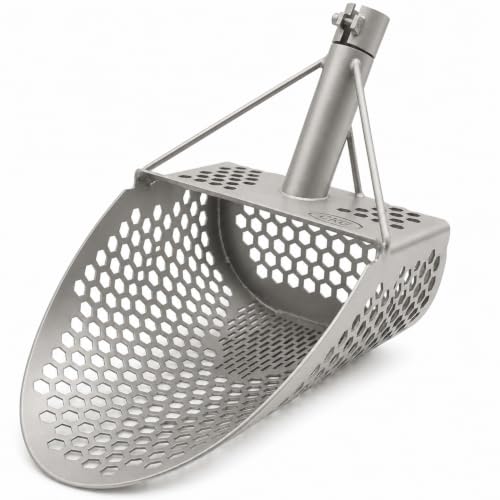
CKG Titanium Sand Scoop
$198.99CKG publishes titanium construction for a heavy duty beach sifter. Titanium is the reason: it does not corrode in salt the way steel does, so the scoop that costs the most is also the one you are least likely to replace. Worth it only if salt water is where you actually hunt.
Best for: salt water hunting as a regular habit rather than a holiday
Check price on Amazon
CKG Stainless Steel Sand Scoop
$194.99CKG publishes anti-corrosion stainless with a carbon fibre handle for strength and corrosion resistance, plus a bag for the rest of the kit. It sits within a few dollars of the titanium scoop, so the choice between them is genuinely about which material you trust rather than about budget.
Best for: people who want the flagship build and prefer stainless
Check price on Amazon
RTG Pro Aluminum 47 inch Mini Water Scoop
$122.88RTG publishes a 5 by 9 inch aluminium bucket on a 1.25 inch handle welded at 20 degrees specifically so you can put your foot on the back of the scoop and push it into the sand. At 47 inches it is built for scooping under water at arm length, which a 33 inch scoop cannot do.
Best for: working the surf line and wading chest deep
Check price on AmazonWho should not buy this tier: Do not buy a titanium or flagship stainless scoop if you hunt fresh water, dry inland beaches or parks. Salt is the only thing these materials are genuinely solving, and on a lake shore a CKG 304 Stainless Sand Scoop will outlive your interest in the hobby. Do not buy a long water scoop if you hunt the towel line, because a 47 inch handle is awkward and heavy on dry sand where a short scoop is faster. And do not buy any scoop for inland work at all: in turf you want a digger that cuts a clean plug, because a scoop in grass leaves a scar that gets permissions withdrawn.
How do you actually recover a target in sand without losing it?
- Pinpoint before you dig. Sweep from two directions and mark the crossing point with your heel. In sand a target moves with every scoop, so the more precisely you start the fewer scoops you need. A Garrett Pro-Pointer AT submersible to 20 feet makes this quick and is the accessory most beach hunters buy second.
- Cut a wide first scoop. Drive the basket in past the depth the machine reported and take a generous bite. A timid first scoop pushes the target sideways and down, and then you are chasing it. On a water scoop, put your foot on the back of the blade and let your weight do the work rather than your shoulder.
- Shake, do not pour. Hold the scoop clear of the hole and shake it side to side so the sand falls out through the holes. Pouring the contents back into the hole is how a small gold chain gets lost. Keep shaking until the basket is nearly empty and you can see what is left.
- Check the scoop with the pinpointer. If the machine says the target is still in the basket, run the pinpointer over the scoop rather than tipping it out. Wet sand holds small items against the mesh, and a thin ring can sit flat against the wall where you will not see it.
- Fill the hole before you move. Push the spoil back in and level it with your boot. On a public beach a line of open holes is what brings a local ordinance down on everybody, and a hole below the tide line still traps an ankle before the tide fills it.
How we chose
None of these have been dug with by us. We did not test any scoop in person and there is no measured sifting comparison behind this page. Material grades, hole sizes, handle lengths and weights are quoted from each maker own listing, named in the sources below, and where a maker does not publish a figure the table says so rather than carrying a guess. The ranking follows the three things that actually decide whether a scoop is worth carrying: how much sand it sheds per shake, how far you have to bend, and how it behaves after a season in salt.
Sources
- CKG titanium, stainless and 304 stainless sand scoop product listings
- CKG carbon fibre sand scoop handle specifications
- RTG 33 inch and Pro 47 inch scoop specifications
- GADFISH stainless sand scoop product listing
- Serious Detecting mesh bottom beach pouch specifications
Frequently asked questions
Do I really need a sand scoop, or will a shovel do?
On a beach you need a scoop. A shovel lifts sand and the sand stays in the blade, so you end up sorting it by hand while the hole collapses. A perforated basket sheds the sand and keeps the target, which is a completely different action. Inland the reverse is true: in turf you want a digger that cuts a plug you can replace, and a scoop would leave a scar.
Is a titanium sand scoop worth the money?
Only if you hunt salt water regularly. Titanium resists salt corrosion far better than steel, which is the whole argument for the price, and CKG sells the CKG Titanium Sand Scoop on exactly that basis. On fresh water, dry sand or inland ground the corrosion problem barely exists, and a 304 stainless scoop at half the price will outlast your interest in the hobby.
What hole size should a sand scoop have?
Large enough to shed wet sand, small enough to hold a thin gold chain. GADFISH publishes 8.5 mm hexagonal holes, which is a fair middle. RTG uses a half inch welded screen on its dry sand scoop, which sheds faster and suits dry sand above the tide line. If you specifically hunt jewellery, choose the smaller holes and accept that each scoop takes an extra shake or two.
How long should the handle be?
Long enough that you are not bending at the waist for every target. RTG publishes a 28 inch fixed handle on its dry sand scoop and 47 inches on the water version. The rule is simple: dry sand rewards a shorter, lighter scoop you can swing quickly, while wading needs the length to reach through water at arm length and to let you push the basket down with your foot.
Will a stainless scoop set off my metal detector?
Any metal near the coil can produce a response, which is why you pinpoint first, then set the scoop down clear of the hole while you swing. In practice this is a technique problem rather than a purchase problem. The bigger consideration is corrosion: salt water will destroy a mild steel scoop in a couple of seasons, and stainless or titanium is what stops that happening.
Researched, not professional advice. This page is compiled from published specifications, manuals and owner-review consensus, not hands-on testing. Target ID numbers, depth figures and settings vary with soil chemistry, moisture, target size, depth, orientation and firmware version, so treat every figure here as a starting point and verify it against your own machine's manual and your own ground. As an Amazon Associate we earn from qualifying purchases.