Where to detect
Metal Detecting in Saltwater: Waterproof Ratings, Salt Response and Corrosion
Quick answer
Salt water is conductive, so a single frequency machine cannot easily separate the salt response from a target response. Use simultaneous multi-frequency or a dedicated salt mode, check the published waterproof depth rating before submerging anything, use wired waterproof headphones because wireless does not work under water, and rinse everything in fresh water afterwards.
Salt water breaks two assumptions at once. The first is electrical: dissolved salt conducts, so wet salt sand and sea water produce a response of their own that a single frequency detector struggles to tell apart from a target. The second is mechanical: salt corrodes everything it touches, including the parts of your machine you never look at, and it keeps working long after you have gone home.
Both problems have known answers, and neither of them is guesswork. The electrical problem is what simultaneous multi-frequency and salt modes exist for. The mechanical problem is solved with fresh water and discipline. What follows attributes every waterproof figure to the maker that publishes it, because a depth rating is the one specification where being approximately right is worth nothing.
Top pick
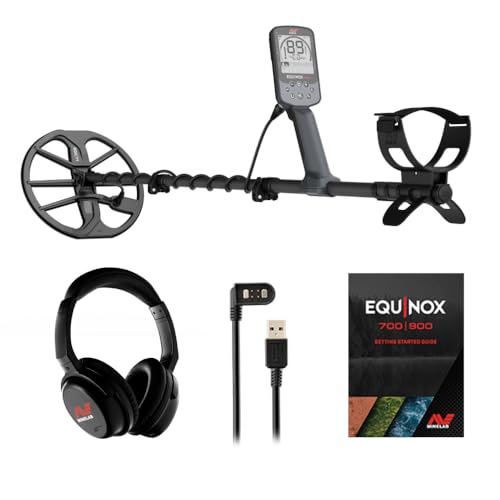
Minelab Equinox 900
Minelab publishes full waterproofing to 16 feet plus Multi-IQ simultaneous multi-frequency, which addresses the salt response and the submersion question in one machine.
Price was accurate when this page was compiled and changes often.
On this page
Why does salt water confuse a detector?
Because it is a conductor, and a detector finds conductors. Sea water and saturated salt sand return a continuous signal that varies with depth, wave action and concentration, and to a single frequency machine that looks like an endless stream of weak targets. The usual symptoms are constant chatter, unstable target ID values and a collapse in usable depth as you drop sensitivity to make the machine bearable.
Simultaneous multi-frequency transmits several frequencies at once and compares the returns, which allows the processing to characterise the salt response and subtract it while keeping genuine targets. That is the whole argument for multi-frequency, and it is why the beach columns in the frequency chart look the way they do. Ground balancing helps with mineralisation but it does not solve salt, which is a distinction covered in the ground balance guide.
What do the makers actually publish for waterproofing?
Read these as the manufacturer statements they are, and read your own manual before submerging anything. A machine rated for submersion is not the same as a machine whose coil is waterproof, and that difference has ended a lot of detectors.
Published submersion ratings in this catalog run from a waterproof coil only on entry machines up to 66 feet on the XP Deus II, with 16 feet the common figure across current mid-range and flagship bodies.
| Model | Published rating | Suits |
|---|---|---|
| Minelab Equinox 900 | Fully waterproof and submersible to 16 ft | Wading, surf and shallow snorkelling |
| Minelab Equinox 700 | Fully waterproof and submersible to 16 ft | The same water work at lower cost |
| Minelab X-Terra Pro | IP68 waterproof to 16 ft, single frequency | Wet ground and wading, not the salt problem |
| Nokta Simplex Ultra | Fully waterproof to 16 ft, carbon fibre shaft | Wading and surf on a mid budget |
| Nokta Double Score | IP68 fully submersible to 16 ft | A waterproof multi-frequency machine |
| Minelab Manticore | Waterproof to 16 ft, IP68 | Depth in mineralised and salt ground |
| XP Deus II | Waterproof to 66 ft, IP68 remote | Diving, and the deepest published rating here |
| Minelab Excalibur II | BBS multiple frequency, 1.5 to 25.5 kHz, built for salt | Diving and surf hunting in salt water |
| Garrett AT Pro | Fully submersible to 10 ft | Shallow water and wet environments |
| Garrett AT Gold | Fully submersible to 10 ft | Rivers and creeks rather than surf |
| Garrett Vortex VX9 | Fully submersible to 16 ft | Lakes, streams and ocean environments |
| Garrett Pro-Pointer AT | Submersible to 20 ft | Any water work, including under a machine that is not |
| Nokta PulseDive | IP68 to 60 m, pulse induction | Snorkelling and shallow diving |
| Minelab PRO-FIND 35 | Fully waterproof to 10 ft | Beach and shallow water pinpointing |
Every rating is quoted from the manufacturer listing or manual for that product. Ratings assume seals and battery doors are intact and correctly closed, which is the operator responsibility and not the maker.
Why does wireless audio stop working under water?
Because the radio signals these systems use do not propagate usefully through water. A low latency wireless set is excellent on a beach and silent the moment your head goes under, which catches people out every season. If you intend to submerge the machine you need a wired waterproof set, and it has to be the one built for your connector.
Minelab publishes Minelab Equinox Waterproof Headphones as the wired waterproof set for submerging an Equinox, Garrett publishes Garrett Submersible Headphones for putting an AT series machine under water, and Thresher Submersible Headphones for Nokta covers the Simplex and Legend, which both go under water while shipping with wireless sets that do not. Gray Ghost Amphibian Headphones for Minelab is the aftermarket submersible option for Minelab machines. Buy this before the trip rather than discovering the problem in the surf.
How do you stop salt destroying the kit?
- Check every seal before you go in. Battery doors, coil connectors and the control pod cover. A seal that is fine on a beach is the failure point once there is pressure behind it.
- Do not exceed the published rating. Ratings are stated for a reason and there is no margin advertised. A machine rated to 10 feet is not a diving machine.
- Rinse everything in fresh water the same day. The machine, the coil, the scoop, the pouch and the headphones. Salt left to dry keeps corroding long after the session ends.
- Pay attention to the connector. Coil and headphone connectors are where salt does its quiet damage. Rinse, then dry them properly before reassembly.
- Dry it before it goes in a bag. A detector sealed damp into a carry bag corrodes faster than one left out. Dry first, then store.
- Choose corrosion resistant tools. Titanium and good stainless survive salt. Mild steel scoops rust out within a season of regular salt use.
- Service the consumables. Coil covers, tip protectors and lanyards are cheap and are what wears first in abrasive wet sand.
Which tools survive salt water?
Titanium and stainless, and the price difference reflects genuine metallurgy rather than branding. CKG Titanium Sand Scoop does not rust in salt water and does not set off the detector, which is the entire argument for what it costs. CKG Stainless Steel Sand Scoop is close to the same money in stainless, and CKG 304 Stainless Sand Scoop is the more affordable 304 stainless version. For wading, RTG Pro Aluminum 47 inch Mini Water Scoop is aluminium and long enough to scoop at arm length under water.
A pinpointer with a serious rating earns its place here too, because a target in a collapsing wet hole is nearly impossible to recover by eye. Garrett Pro-Pointer AT is published as submersible to 20 feet and Nokta PulseDive Pinpointer is a pulse induction unit rated IP68 to 60 metres that Nokta describes as stable in salt water. Add Pinpointer Tip Protectors and Lanyard and a lanyard, because wet sand is abrasive and a dropped pinpointer in surf is gone.
What about the water itself?
Treat the sea as the hazard it is rather than as a site with better finds. Cold water removes dexterity quickly, currents along a beach are strongest exactly where the scours you want to hunt have formed, and a scoop handle is a poor swimming aid. Work with somebody else present where you can, tell a person on shore what you are doing, and set a turnaround time before the tide makes the decision for you.
The broader hazard list, including what to do about suspected ordnance washed out of the sand, is covered in the safety and utilities guide, and it matters more on a beach than anywhere else because coastal ground has a habit of producing military material. The general beach technique, zones and tide planning are in the beach guide.
Sources
- Minelab Equinox 700 and 900 instruction manual and product specifications
- Minelab Excalibur II product specifications
- XP Deus II product specifications
- Garrett AT series and Pro-Pointer AT product specifications
- Nokta PulseDive and Simplex Ultra product specifications
Frequently asked questions
Can I use any waterproof detector in the sea?
Only within its published rating, and waterproofing is a separate question from whether it handles salt well. A single frequency machine rated to 16 feet will survive the water and still struggle to tell the salt response from a target. For salt you want simultaneous multi-frequency or a dedicated salt mode, and for submersion you want the published depth figure in the manual rather than an assumption.
Why do my wireless headphones cut out in the water?
Because the radio link does not carry through water. This is normal rather than a fault, and it affects every wireless system regardless of price. If you intend to submerge the machine you need the wired waterproof headphones made for your connector, such as the Minelab Equinox waterproof set or the Garrett submersible set for AT series machines. Buy them before the trip.
Is a titanium scoop worth the money?
In regular salt use, yes. Titanium does not rust in salt water and does not produce a signal on the detector, which is the whole argument for the price. Stainless is the sensible middle ground and 304 stainless versions cost considerably less. Mild steel scoops are a false economy in salt, because they corrode out within a season of regular use.
What do I do with my machine after a salt session?
Rinse it in fresh water the same day, including the coil, connectors, scoop, pouch and headphones, then dry it properly before it goes into a bag. Salt left to dry keeps working on seals and contacts long after you have finished. Pay particular attention to the coil and headphone connectors, which are where corrosion causes expensive and unobvious damage.
Can I keep something I find on a wreck site?
No. Wreck material is protected almost everywhere and removing it is an offence in most jurisdictions, quite separately from any treasure reporting duty. If you find material that appears to come from a wreck, leave it, note the location and contact the relevant authority. The same applies to anything that looks like ordnance, which should be reported to the police rather than touched.
Researched, not professional advice. This page is compiled from published specifications, manuals and owner-review consensus, not hands-on testing. Target ID numbers, depth figures and settings vary with soil chemistry, moisture, target size, depth, orientation and firmware version, so treat every figure here as a starting point and verify it against your own machine's manual and your own ground. As an Amazon Associate we earn from qualifying purchases.