Diggers and scoops
CKG Titanium Sand Scoop Review: Worth It in Salt, an Extravagance in Fresh
Quick answer
Buy the titanium scoop if you hunt salt water beaches often enough that corrosion has already cost you a scoop. Skip it for fresh water, dry sand or occasional beach trips, where CKG 304 Stainless Sand Scoop at $89.99 does the same work.
Reviewed here
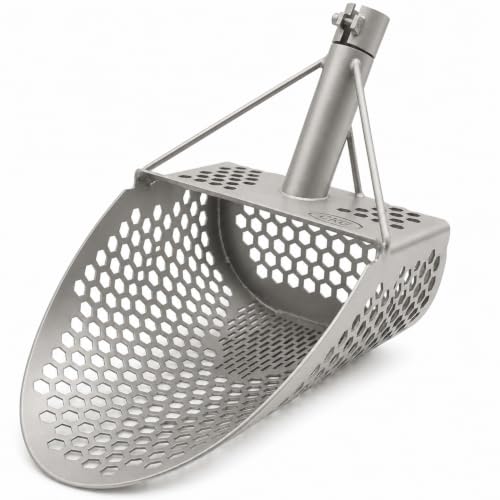
CKG Titanium Sand Scoop
Titanium does not corrode in salt water and does not give a detector a signal of its own, which is what justifies a scoop at this price for regular salt beach hunters.
Price was accurate when this page was compiled and changes often.
The CKG Titanium Sand Scoop is the scoop people buy when they have already destroyed a cheaper one. Titanium does not rust in salt water and does not set off a detector the way some steels can, and those two properties are the entire argument for the price, which CKG sets at $198.99.
Both properties are real, and both matter only in a specific place. Salt water is relentless on steel, and a scoop lives its whole life in wet sand and surf. On a freshwater lake shore or dry sand above the tide line, the same scoop is doing work that a much cheaper tool does identically. The saltwater guide covers what salt does to an entire kit, not just to a scoop.
On this page
- What does a sand scoop actually have to survive?
- How does it compare with the scoops people cross-shop?
- What does each scoop listing publish?
- The honest weakness: titanium only pays in salt, and this listing publishes almost nothing
- What do owners consistently report?
- Who should buy it, and who should skip it
- What should you buy instead?
What does a sand scoop actually have to survive?
Constant immersion in the single most corrosive environment in the hobby, plus mechanical abuse. A beach scoop is pushed into compacted wet sand, levered against buried stones, shaken hard to sift, and then left in a car boot still wet and salty. Mild steel in that cycle is finished in a season, and the failure is not cosmetic: rust weakens the welds where the basket meets the handle, which is exactly where the load goes. The same salt is working on the detector in your other hand, which is why the waterproof machines roundup matters as much as the scoop does on a beach kit.
The second consideration is electrical rather than structural. A scoop swung near a coil or laid down beside one can give a response of its own, and a detector reacting to your own tools wastes time on every target. That is why material choice on beach kit is discussed more seriously than it is elsewhere, and why the beach detecting guide treats the scoop as part of the detecting system rather than as a spade.
Hole size is the third factor and it is the one buyers overlook. Big holes sift faster and let small gold chain and thin rings through. Smaller holes keep the fine jewellery and take longer per scoop. GADFISH Stainless Sand Scoop publishes 8.5 mm hexagonal holes and RTG 33 inch Beach Sand Scoop publishes a half inch welded wire screen, which are genuinely different tools for different targets.
How does it compare with the scoops people cross-shop?
Published figures only. The gaps in the titanium row below are in the maker own listing, which is part of this review.
CKG publishes titanium and stainless flagship scoops within a few dollars of each other, while its own 304 stainless model sits at less than half the price of either.
| Model | Price | Material | Handle length |
|---|---|---|---|
| CKG Titanium Sand Scoop | $198.99 | Titanium | - |
| CKG Stainless Steel Sand Scoop | $194.99 | Stainless steel | - |
| CKG 304 Stainless Sand Scoop | $89.99 | 304 stainless steel | - |
| RTG Pro Aluminum 47 inch Mini Water Scoop | $122.88 | Aluminium | 47 in |
Figures are taken from each manufacturer's own published listing and specification sheet. A dash means the maker does not publish that figure for that model, not that the feature is absent.
What does each scoop listing publish?
This is the table that makes the case against the titanium, and every figure in it comes from the makers themselves.
RTG publishes bucket dimensions, handle length and screen gauge for scoops costing under half the titanium price, while the titanium listing publishes its material and little else.
| Scoop | Material published | Handle published | Dimensions published |
|---|---|---|---|
| CKG Titanium Scoop | Titanium | Not published in this listing | Not published in this listing |
| CKG Stainless Scoop | Anti-corrosion stainless steel | Carbon fibre handle | Not published in this listing |
| CKG 304 Stainless Scoop | 304 stainless steel | Not published in this listing | Shark tooth sifter design |
| RTG Pro Aluminium 47 in | Aluminium | 1.25 in aluminium, welded at 20 degrees | Bucket 5 in by 9 in |
| RTG 33 in Beach Scoop | 16 gauge steel | Fixed 28 in galvanised conduit | 5 in diameter, half inch welded screen |
Quoted from each maker own published listing. The CKG titanium listing publishes a single descriptive line, which is why four of its cells here say not published.
The honest weakness: titanium only pays in salt, and this listing publishes almost nothing
Titanium is the correct material for a scoop that lives in sea water. It is an extravagance anywhere else. If you hunt a freshwater lake shore, a river bank or dry sand above the tide line, corrosion is a slow problem rather than an urgent one, and CKG 304 Stainless Sand Scoop at $89.99 will serve for years. That is less than half the money for the same job, and the difference buys a pinpointer outright. Buy titanium when salt has already destroyed something of yours, not in anticipation.
The pricing inside CKG own range makes this stranger still. CKG Stainless Steel Sand Scoop is published at $194.99, within a few dollars of the titanium, and its listing publishes a carbon fibre handle, a sifting design and an included bag. So the real choice is not titanium against stainless at a large premium: it is two flagship scoops at almost the same price against a 304 stainless model at less than half. Most beach hunters should be choosing between the cheap one and one of the flagships, and the decision should turn on how much salt time the scoop will see.
Third, this listing is unusually quiet. CKG publishes one line for the titanium scoop. There is no published hole size, no basket dimension, no handle length, no weight. At $198.99 that is a fair complaint, particularly when RTG 33 inch Beach Sand Scoop at $88.95 publishes a 5 inch diameter basket, a half inch welded wire screen, 16 gauge steel, a 28 inch handle and a weight under two pounds. If hole size matters for the jewellery you are chasing, buy from a listing that tells you what it is. One upgrade applies to any scoop: CKG Carbon Fiber Sand Scoop Handle at $86.99 is what makes a heavy scoop usable for a full tide.
What do owners consistently report?
Published owner reviews of titanium scoops are consistent on the two points that justify them. The first is that corrosion simply stops being a maintenance task, which matters to people who hunt salt several times a week and are tired of rinsing, drying and watching welds. The second is weight: titanium scoops are reported as noticeably lighter in the hand than steel of equivalent strength, which is what decides whether you work a whole tide or half of one. That is the same argument the Sampson shovel review makes about carrying weight on land: the tool you actually bring is the one that finds things.
The consistent complaint is the price, usually phrased as a question about whether the buyer needed it. Owners who hunt fresh water or dry sand are candid that the same results would have come from a cheaper tool. The other recurring theme is the handle: scoop handles bend and fatigue before baskets do, which is why carbon fibre handles are sold separately and why RTG publishes a handle welded at 20 degrees so you can push it with your foot. Pair any beach scoop with a draining pouch such as Mesh Bottom Beach Finds Pouch with pinpointer holster at $21.95, because a pouch full of wet sand is its own punishment.
Who should buy it, and who should skip it
Buy it if:
- You hunt salt water beaches regularly, not occasionally.
- Corrosion has already ended a scoop for you, which is the honest trigger for this purchase.
- You want the lightest durable basket for working a full tide.
- You are tired of your own tools giving your detector a signal.
Skip it if:
- You hunt fresh water, river banks or dry sand, where stainless is entirely sufficient.
- You are trying beach detecting for the first time and do not yet know if it suits you.
- You need a published hole size for chasing fine chain, which this listing does not give.
- The money would be better spent on the machine. See the beach machine roundup.
What should you buy instead?
Three alternatives, each better than the titanium scoop at one specific thing.

CKG 304 Stainless Sand Scoop
$89.99CKG publishes the same sifting design in 304 stainless steel at $89.99, which is the sensible scoop for anyone not living on a salt beach.
Best for: a first beach scoop and fresh water
Check price on Amazon
RTG Pro Aluminum 47 inch Mini Water Scoop
$122.88RTG publishes a 47 inch aluminium scoop with a 5 by 9 inch bucket and a handle welded at 20 degrees so you can drive it with your foot, for scooping under water at arm length.
Best for: wading and surf work
Check price on Amazon
GADFISH Stainless Sand Scoop
$32.99GADFISH publishes 201 stainless with a detachable long pole and 8.5 mm hexagonal sift holes at $32.99, which is enough to find out whether beach hunting suits you.
Best for: trying beach detecting once
Check price on AmazonHow we chose
We did not test these machines in person and we publish no find claims. Picks are researched from manufacturer specifications and owner manuals, published listing features, waterproof ratings and warranty terms, and the recurring themes in verified owner reviews. We favour the established detector brands because coils, shafts and control boxes have to stay available years after a model is discontinued, and we place every pick in the tier where its price and capability honestly belong.
Sources
- CKG titanium and stainless sand scoop product listings
- RTG beach scoop product specifications
- GADFISH stainless sand scoop product listing
- Published owner reviews of CKG sand scoops
Frequently asked questions
Is a titanium sand scoop worth the money?
In salt water, for a frequent beach hunter, yes. Titanium does not corrode in sea water and does not give your detector a response of its own, and a scoop lives permanently in wet sand and surf. In fresh water or on dry sand, it is an expensive answer to a slow problem, and a 304 stainless scoop at less than half the price does the same job for years.
Titanium or stainless steel sand scoop: which should I buy?
Buy stainless unless salt has already cost you a scoop. CKG publishes a 304 stainless model at well under half the titanium price and a flagship stainless scoop within a few dollars of it, so within one range the meaningful choice is budget stainless against a flagship rather than titanium against steel. Let the amount of salt time decide, not the material name.
What size holes should a sand scoop have?
It depends on what you are chasing. Larger holes sift faster and let thin chain and small rings pass straight through. Smaller holes keep fine jewellery and take longer per scoop. Published examples include 8.5 mm hexagonal holes on the GADFISH scoop and a half inch welded wire screen on the RTG. If fine gold chain is your target, buy from a listing that states its hole size.
Do I need a long handled scoop for beach detecting?
For dry sand, a long handle saves your back because you never bend. For wading, a long handle is essential since you are scooping under water at arm length, and RTG publishes a 47 inch aluminium model with the handle welded at 20 degrees so you can push it with your foot. For working the tide line only, a shorter scoop is quicker to control.
How do you stop a sand scoop rusting?
Rinse it in fresh water after every salt session and dry it rather than storing it wet, which is when corrosion does most of its work. Watch the welds where the basket meets the handle, since that is where rust weakens a scoop first and where it fails under load. Titanium and quality stainless slow the process down, and neither removes the need to rinse.
Researched, not professional advice. This page is compiled from published specifications, manuals and owner-review consensus, not hands-on testing. Target ID numbers, depth figures and settings vary with soil chemistry, moisture, target size, depth, orientation and firmware version, so treat every figure here as a starting point and verify it against your own machine's manual and your own ground. As an Amazon Associate we earn from qualifying purchases.