Minelab Equinox 900
Equinox 900 Depth Chart: Realistic Ranges by Target, Coil and Soil
Quick answer
With the stock 11 inch coil, the Equinox 900 realistically reaches roughly 5 to 10 inches on a US coin in average soil, less in mineralised ground and a little more in damp mild soil. Small gold is a 1 to 5 inch proposition on any machine, including this one.
Minelab does not publish a depth figure for the Minelab Equinox 900, and that is to their credit, because a single depth number for a detector is meaningless. Depth is a property of the target, the coil, the soil and the operator at least as much as of the machine. What can be said honestly is the range owners consistently report, and the conditions that push it to one end or the other.
Nothing on this page has been depth-tested by this site. The ranges below are wide because the honest ranges are wide, and the only figures that will ever describe your own ground are the ones you write down after burying known targets in it. The expected detection depth calculator takes target size, coil diameter and mineralisation and gives a range for your own inputs.
Top pick
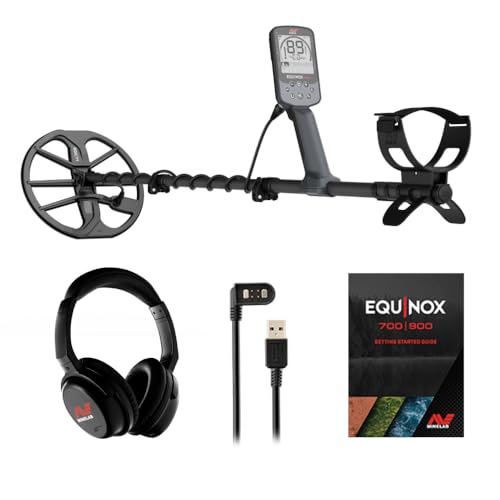
Minelab Equinox 900
Shipping with both the 11 inch and 6 inch coils means the machine covers the depth and the separation end of this chart without a second purchase.
Price was accurate when this page was compiled and changes often.
How deep does the Equinox 900 reach on each target?
With the stock Minelab EQX 11 Coil (11 inch) coil and a competent slow sweep. Read the low end as bad ground and the high end as a good day.
With the stock 11 inch coil, a US coin sits in the region of 5 to 10 inches in average soil, dropping to 3 to 6 inches in heavily mineralised ground.
| Target | Mild damp soil | Average soil | Mineralised or very dry |
|---|---|---|---|
| Small gold, under 1 gram | 2 to 5 in | 1 to 4 in | Under 3 in |
| Thin gold chain | 1 to 4 in | 1 to 3 in | Surface only |
| US nickel | 6 to 10 in | 4 to 8 in | 3 to 5 in |
| Silver or clad dime | 6 to 10 in | 5 to 8 in | 3 to 6 in |
| Silver quarter | 8 to 12 in | 6 to 10 in | 4 to 7 in |
| Gold ring, mid to large | 6 to 11 in | 5 to 9 in | 3 to 7 in |
| Button, buckle, small relic | 6 to 11 in | 5 to 9 in | 3 to 7 in |
| Large iron relic | 12 to 20 in | 10 to 16 in | 7 to 12 in |
Ranges reported by owners across the Equinox platform, not measurements. Minelab publishes no depth specification for this machine, and any site that prints one has invented it.
What does the coil change?
More than the mode does. The Minelab Equinox 900 ships with both the Minelab EQX 11 Coil (11 inch) and the 6 inch Minelab EQX 06 Coil (6 inch), and the Minelab EQX 15 Coil (15 inch) is the usual third purchase.
The 15 inch coil buys depth on large targets and loses separation, while the 6 inch coil loses depth on coins and finds targets in trash that the others never report.
| Coil | Coin depth | Small gold | Separation in iron | Best used on |
|---|---|---|---|---|
| EQX 06, 6 in | Roughly 1 to 2 in less than stock | Best of the three | Best | Old house sites, picnic ground, dense iron |
| EQX 11, 11 in | The baseline for this chart | Good | Fair | General detecting |
| Coiltek 10 by 5 | Close to stock | Very good | Very good | Iron-infested ground where coverage still matters |
| EQX 15, 15 by 12 in | Deepest on large targets | Weakest | Poor in dense trash | Open fields, pasture, dry beach |
| Coiltek 15 in | Similar to the EQX 15 | Weakest | Poor in dense trash | Large open ground |
Minelab publishes the EQX 15 as having more depth capability than the EQX 06 and 11. The relative figures here are directional, not measured.
What settings cost you depth on this machine?
Sensitivity set too low, ground balance left stale, and a fast sweep. Of those, sensitivity is the one people get wrong in both directions: set too high the machine chatters and you start ignoring it, set too low it goes quiet and shallow. The honest approach is to raise it until the machine becomes unstable and then back off two or three points.
Recovery speed is the deliberate trade. A high recovery speed separates targets in trash and costs a little depth; a low one goes deeper on clean ground and blends adjacent targets. On a ploughed field with no iron there is no reason to run a high recovery speed, and on a picnic ground there is no point running a low one. The settings by site type page sets out where each belongs.
How do you find out what your own machine does?
Bury known targets at known depths, in ground you have permission to dig, and leave them to settle through a few rains before you believe the readings. Freshly disturbed soil is easier to detect through than undisturbed soil, so a test done on the day of burial flatters every machine. Sweep each target in the modes you actually hunt in, and write the results down.
Do it again after a firmware update and again in the opposite season. The two sheets together will tell you more about your ground than any chart, and they will stop you blaming the machine for what the soil is doing. The master depth chart gives you the cross-machine context for what you find.
Sources
- Minelab Equinox 700 and 900 instruction manual
- Minelab Equinox 900 published product specifications
- Minelab EQX 06, EQX 11 and EQX 15 coil specifications
Frequently asked questions
How deep will the Equinox 900 detect a coin?
Realistically in the region of 5 to 10 inches on a US coin in average soil with the stock 11 inch coil, more in damp mild ground and as little as 3 to 6 inches in heavily mineralised soil. Minelab publishes no depth specification, so treat any exact figure with suspicion, including this range, and calibrate against buried targets in your own ground.
Does the Equinox 900 go deeper than the Equinox 700?
Not in a way most owners can point to on coin-sized targets. The two share the Multi-IQ platform, the same body and the same waterproofing. The 900 adds a Gold mode, two more single frequencies and the 6 inch coil in the box. Those change what it finds and where, rather than how far down it reaches on a quarter in a park.
Will the 15 inch coil make a big difference to depth?
On large targets in clean open ground, yes, and Minelab publishes the EQX 15 as having more depth capability than the 06 and 11. On coin-sized targets the gain is modest, and in trash the loss of separation usually costs more finds than the depth gains. Buy it for pasture, ploughed land and dry beach rather than as a general upgrade.
Why does my machine seem to have lost depth?
Check the ordinary causes first. Dry soil detects noticeably worse than damp soil, so the same site changes between seasons. A stale ground balance, a lowered sensitivity you forgot about, a waterlogged or cracked coil, and new electrical interference nearby all reduce depth quietly. Re-run your test garden before concluding the machine has a fault.
Does running a single frequency instead of Multi-IQ change depth?
It changes which targets respond more than how far down the machine reaches. A low single frequency biases towards high conductors such as silver, a high one towards small gold. Multi-IQ is the sensible default for mixed ground because it covers several bands at once, which is the whole reason Minelab built the platform around it.
Researched, not professional advice. This page is compiled from published specifications, manuals and owner-review consensus, not hands-on testing. Target ID numbers, depth figures and settings vary with soil chemistry, moisture, target size, depth, orientation and firmware version, so treat every figure here as a starting point and verify it against your own machine's manual and your own ground. As an Amazon Associate we earn from qualifying purchases.