Minelab Equinox 900
Minelab Equinox 900 Target ID Chart: What Each Number Means
Quick answer
On the Equinox 900, iron reads below zero, foil and small gold about 2 to 12, a US nickel 12 to 13, pull tabs 9 to 20, zinc cents 20 to 24, copper cents and silver dimes 24 to 29, and quarters 28 to 33. Minelab publishes 119 high-resolution target IDs on this machine.
The Minelab Equinox 900 prints a target ID drawn from what Minelab calls 119 high-resolution target IDs. In practice that means the familiar non-ferrous scale running up to 99, plus a ferrous range below zero, which is why iron on this machine reads negative rather than crowding into the bottom of a 0 to 99 range. The extra resolution is the reason Equinox owners talk about two-point differences that would be invisible on a coarser machine.
The numbers below are the bands Equinox owners consistently report. They are not measurements from any machine held by this site, and they are not guarantees. Mode matters: the same coin can read a point or two apart in Park 1 and Field 2. So does the coil, the firmware and the ground. Treat the table as the starting point and your own buried targets as the authority. The master target ID chart explains why those bands sit where they do across every machine.
Top pick
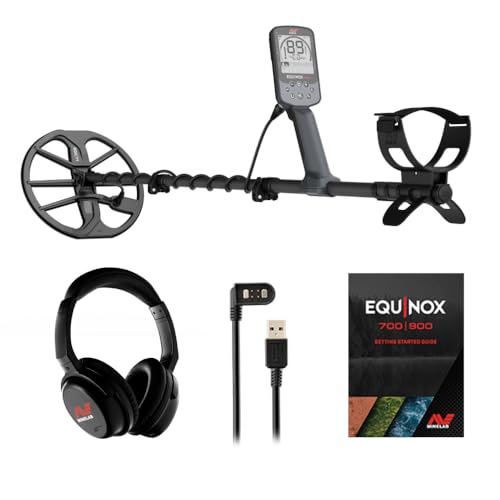
Minelab Equinox 900
The 119 target IDs and the choice of six single frequencies are what make the ID numbers on this machine worth charting in the first place.
Price was accurate when this page was compiled and changes often.
On this page
What target ID does each common find give on the Equinox 900?
Bands assume the stock Minelab EQX 11 Coil (11 inch) coil, a target lying flat at normal hunting depth, and a general-purpose mode such as Park 1 or Field 1.
On the Equinox 900, a US nickel typically reads 12 to 13, a zinc cent 20 to 24, a silver dime 25 to 29 and a silver quarter 30 to 33, with iron falling below zero.
| Target | Typical Equinox 900 ID | Confidence | What else lands there |
|---|---|---|---|
| Iron nail, ferrous trash | Below 0 | High | Nothing you want |
| Rusted bottle cap | Jumps between negative and 20s | Low, by nature | Mimics a coin on a single sweep |
| Thin foil | 2 to 8 | Moderate | Small gold, chain links |
| Small gold jewellery | 2 to 12 | Low, size dependent | Foil, small tabs |
| Lead weight | 8 to 20 | Moderate | Tabs, mid gold |
| Beaver-tail pull tab | 9 to 16 | High | Nickels, small gold rings |
| US nickel | 12 to 13 | High | Beaver-tail tabs |
| Square pull tab | 17 to 20 | High | Zinc cents, gold rings |
| Gold ring, mid to large | 12 to 25 | Low, size dependent | Tabs, screw caps, zinc |
| Zinc US cent | 20 to 24 | High | Square tabs, screw caps |
| Aluminium screw cap | 22 to 30 | Moderate | Cents, dimes |
| Copper US cent | 24 to 28 | High | Silver dimes |
| Silver dime | 25 to 29 | High | Copper cents |
| Clad quarter | 28 to 31 | High | Silver quarters |
| Silver quarter | 30 to 33 | High | Clad quarters |
| Silver half dollar | 32 to 36 | Moderate | Large flat aluminium |
| Large silver, silver dollar | 36 to 40 | Moderate | Big aluminium sheet |
Bands are what Equinox owners consistently report, not measured figures. Soil chemistry, moisture, depth, orientation, corrosion, coil choice and firmware all shift them. Confidence refers to how tightly the target usually holds its band, not to the accuracy of this table.
Why do the numbers move between modes?
Because each mode changes the frequency weighting and the processing behind the ID. Park and Field on the Minelab Equinox 900 weight the response for coin-sized non-ferrous targets; Beach compensates for conductive salt; Gold is built around small low-conductive targets and behaves differently enough that IDs there are not directly comparable with Park. Minelab lists four modes on this machine, each with two profiles, which is eight sets of behaviour to learn.
Frequency matters too. The manual lists six single frequencies alongside Multi-IQ, and switching to a high single frequency will pull low conductors up and push high conductors around. If you keep changing frequency you will keep changing your IDs, which is a good argument for picking one setup for a site and staying in it. The settings by site type page covers which mode belongs on which ground.
What does depth do to the Equinox 900 ID?
The same direction as every machine: lower and less stable. The table below is a rough guide to how far a reading drifts as the target gets further from the coil.
A silver quarter that reads a steady 30 near the surface commonly drifts a few points low and becomes unstable by the time it sits nine or ten inches down.
| Target depth | Typical ID behaviour | What to do about it |
|---|---|---|
| 0 to 3 in | Stable, repeatable from every direction | Trust the number |
| 3 to 6 in | Stable, may drift 1 to 2 points low | Trust the number, check from two directions |
| 6 to 9 in | Drifts 2 to 4 points low, occasional jumps | Sweep from four directions before judging |
| 9 in and beyond | Unstable, often reads well below the surface value | Dig it if it repeats at all, or leave it marked and come back in wetter ground |
General behaviour reported by owners across the Equinox platform. Mineralised ground brings each of these effects on at shallower depths.
How do you calibrate the chart to your own ground?
Bury known targets, in ground you own or have written permission to dig, at two inches and at six inches. Let the soil settle through a few good rains, then sweep each one in Park 1, Field 1 and whichever beach or gold profile you actually use, and write down what the machine says. That sheet beats every chart published anywhere, including this one, because it describes your soil rather than an average of everybody else.
Repeat it after firmware updates, because processing changes move IDs, and repeat it in a wet season and a dry one. A pinpointer such as Minelab PRO-FIND 40 or Garrett Pro-Pointer AT makes recovery quick enough that you will actually do the test rather than skip it. The depth chart gives you sensible depths to bury at.
Which ID bands should an Equinox 900 owner dig?
If you want gold, everything from about 2 to 25 that repeats, which means accepting a large number of tabs and foil scraps per ring. If you want coins, 20 and up, and resist the temptation to notch out the 20s because that is where zinc cents and some older coins live. On hunted-out ground, run the Minelab EQX 06 Coil (6 inch) and dig repeating signals you would ignore with the big coil, because separation rather than depth is what is leaving finds behind.
The one band worth special attention is anything reading high but sounding small and faint. That is the classic deep silver signature, and it is the main reason to keep sensitivity as high as the ground allows. The Equinox 900 depth chart puts ranges on how deep that can reasonably be.
Sources
- Minelab Equinox 700 and 900 instruction manual
- Minelab Equinox 900 published product specifications
- Minelab EQX 06, EQX 11 and EQX 15 coil specifications
Frequently asked questions
What target ID does a silver quarter give on the Equinox 900?
Commonly 30 to 33 on the Equinox scale for a shallow, flat coin, with clad quarters a point or two below that. Once the coin sits deeper than about six inches the reading tends to drift a few points low and to jump between sweeps. Mineralised soil brings that drift on earlier. Bury a known quarter in your own ground and record what your machine says before trusting any published figure.
Why does my Equinox 900 show negative numbers?
Negative IDs are the ferrous end of the scale. Minelab publishes 119 high-resolution target IDs on the 700 and 900, which is a ferrous range below zero plus the non-ferrous scale above it. Most negatives are iron and can be ignored, but large iron objects and rusted bottle caps sometimes throw a positive number on one sweep and a negative one on the next, which is itself a useful tell.
Do the Equinox 900 and Equinox 800 read the same numbers?
Close, but not guaranteed identical. Both run Multi-IQ on the same general ID scale, so charts transfer usefully between them, and most targets land within a point or two. Processing and firmware differ between generations, and Minelab publishes 119 target IDs for the current pair. If you are moving from an 800 to a 900, re-walk your test garden rather than assuming your old numbers carried over.
Does the coil change the target ID?
It can, by a small amount, and it changes stability more than it changes the number. Swapping the stock EQX 11 for the smaller EQX 06 usually gives tighter, more repeatable IDs in trash because fewer targets sit under the coil at once. The larger EQX 15 tends to blur adjacent targets together, which produces averaged readings that belong to neither object.
Should I use notch discrimination on the Equinox 900?
Sparingly. Notching out the pull tab range removes most gold jewellery with it, because tabs and rings share the same band on every machine ever built. A better habit on trashy ground is to leave the machine open, run a small coil for separation, and let the tones do the sorting. Reserve notching for sites where one specific piece of modern trash dominates everything.
Researched, not professional advice. This page is compiled from published specifications, manuals and owner-review consensus, not hands-on testing. Target ID numbers, depth figures and settings vary with soil chemistry, moisture, target size, depth, orientation and firmware version, so treat every figure here as a starting point and verify it against your own machine's manual and your own ground. As an Amazon Associate we earn from qualifying purchases.