Best supporting kit
Best Metal Detector Carry Bags: Length Is the Only Specification
Quick answer
Buy a bag long enough to take the detector assembled, because a bag that needs the machine stripped down never gets used. The 53 inch Heavy Duty Detector Carry Bag at $34.95 is 53 inches and takes most machines with the coil still on. Measure yours first.
There is one specification on a detector carry bag and it is the internal length. Everything else is padding, pockets and price. If the bag is long enough to swallow the machine fully assembled with the coil attached, you will use it every trip. If it is not, you will unbolt the coil twice per outing for about three weeks and then start throwing the detector across the back seat loose, which is how coils get cracked and shafts get bent.
That sounds obvious and it is the mistake almost everybody makes, because bags are listed by external dimensions and machines are listed by their collapsed length. Minelab publishes 24 inches collapsed for the Minelab Equinox 900, Nokta publishes 25 inches for the Nokta Simplex Ultra and Garrett publishes 24.75 inches for the Garrett Vortex VX9. Those are folded figures with the coil swung round. Assembled and ready to swing, the same machines are four feet or more, which is why the bags that work are fifty inches and up.
Top pick
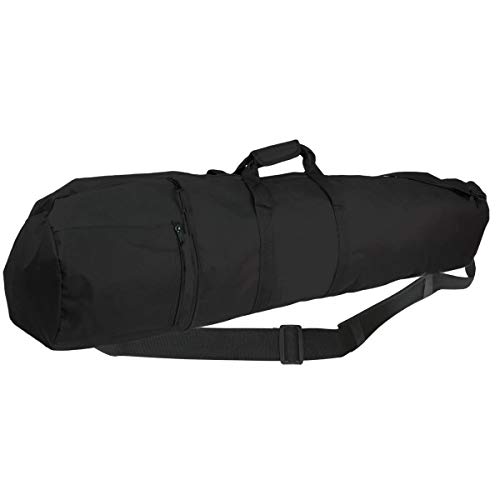
53 inch Heavy Duty Detector Carry Bag
Published at 53 by 19 by 11.5 inches with reinforced stitching and a water-beading interior, and listed as compatible with the ACE series, Apex, AT Pro, AT Max, Vanquish, Equinox, Simplex, Legend, Deus II and Fisher F22 and F44 without removing the searchcoil, at $34.95.
Price was accurate when this page was compiled and changes often.
On this page
- What length of bag does your detector actually need?
- Beginner: something padded, immediately
- Intermediate: the bag that takes it assembled every time
- Expert: weather, weight and a full harness
- How do the carry bags and harnesses compare?
- What should go in the bag besides the detector?
- Does a bag matter for storage as well as transport?
What length of bag does your detector actually need?
Measure the machine assembled, in the position you would swing it, from the end of the handgrip to the front edge of the coil. For most adult-sized detectors with the shaft set for a person of average height that lands somewhere between 45 and 52 inches. Then buy a bag longer than that, not equal to it, because a bag you have to force is a zip you will break.
The two bags in this catalog that are explicitly sold on that basis publish their figures. The 53 inch Heavy Duty Detector Carry Bag is listed at 53 by 19 by 11.5 inches and its listing names the machines it takes without removing the searchcoil, which is an unusually useful thing for a listing to say: the ACE 200, 250, 300 and 400, the Apex, the AT Pro and AT Max, the Vanquish 340, 440 and 540, the Equinox, the Simplex, the Legend, the Deus II, Bounty Hunter machines and the Fisher F22 and F44. The High Plains 50 inch Detector Carry Bag is published at 50 inches and described as fitting most fully assembled S-curve style detectors.
The Bounty Hunter Detector Carrying Case is the exception worth understanding rather than avoiding. Bounty Hunter publishes it at 28 by 10 inches and 1.8 lb, designed for S-rod configurations. That is a bag for a collapsed machine, and its argument is weather-resistant nylon and portability rather than length. If you already break your detector down for transport anyway, it is a perfectly sensible purchase. If you do not, it is the wrong shape entirely.
Beginner: something padded, immediately
The first bag exists to stop the machine rolling around a car boot with a shovel. That is not a small thing: a serrated blade loose beside a coil is how coils get scored, and a control box under a toolbox is how screens get cracked. Any padded bag long enough for the assembled machine solves it.
Buy on length and then on pockets. A side compartment for headphones, a digger and a pinpointer is what stops those items travelling loose as well, which is the second half of the same problem.

High Plains 50 inch Detector Carry Bag
$23.95High Plains publishes a 50 inch bag that fits most fully assembled S-curve detectors, in sturdy canvas, with a 14 inch side zip compartment for headphones, diggers and pointers, a smaller 6.5 inch pocket for batteries and magnifiers, and detachable reinforced nylon straps, at $23.95.
Best for: a first carry bag for an assembled machine
Check price on Amazon
LimbSaver Comfort-Tech Metal Detector Sling
$20.23LimbSaver publishes an adjustable shoulder sling that distributes the detector weight across the upper body, made from its vibration-dampening NAVCOM material, with a universal one-click connection and left or right hand use, at $20.23.
Best for: anyone detecting more than an hour at a time
Check price on AmazonIntermediate: the bag that takes it assembled every time
This is the tier where the bag stops being a compromise. A 53 inch bag with a water-beading lining takes the machine with the coil on, takes the headphones and the pinpointer in the same trip, and can be wiped out after a wet day rather than left to grow mould around a damp coil.
The sling belongs here as much as the bag. The injury detectorists actually get is not dramatic, it is a slow ache in the forearm and elbow from holding a two and a half to three pound machine out in front of the body for hours, and a sling takes that load onto the shoulder instead.
53 inch Heavy Duty Detector Carry Bag
$34.95Published at 53 by 19 by 11.5 inches with reinforced stitching, a water-beading interior for quick cleanup and an adjustable shoulder strap, and listed as compatible with most current machines without removing the searchcoil, at $34.95.
Best for: transport and storage of an assembled machine
Check price on Amazon LimbSaver Comfort-Tech Metal Detector Sling
$20.23LimbSaver publishes a contoured design that keeps the sling in place and the detector balanced, using NAVCOM vibration-dampening material, at $20.23. It is the least money on this page that changes how long you can hunt.
Best for: longer sessions with a mid-weight machine
Check price on AmazonExpert: weather, weight and a full harness
Two different problems get solved here. The Bounty Hunter Detector Carrying Case is about weather and the coil: Bounty Hunter publishes heavy-duty weather-resistant nylon, a rust-resistant zipper and reinforced handles, which is the specification you want if the bag lives in a truck bed rather than a hallway.
The harness is about the machines that are genuinely heavy, or about shoulders that already complain. A sling moves the load to one shoulder. A harness spreads it across both and adds a bungee so the machine effectively floats, which is what makes an all-day hunt possible with a heavier flagship.

Bounty Hunter Detector Carrying Case
$47.72Bounty Hunter publishes heavy-duty weather-resistant nylon that shields against rain, dust and scratches, a rust-resistant zipper, reinforced carry handles, an outer accessory pocket, and a 28 by 10 inch frame at 1.8 lb, made in the USA, at $47.72.
Best for: keeping a collapsed machine out of the weather
Check price on Amazon
Detecting Harness and Swing Support
$36.99Published with 8 adjustment points and 8 attachment points for accessories, a padded and ventilated back cushion, a wide strap, one-handed bungee adjustment and a 1.5 m waist belt fitting up to a 59 inch waist, at $36.99.
Best for: heavy machines, long days and shoulder trouble
Check price on AmazonWho should not buy this tier: Do not buy a harness for a light machine. Nokta publishes 2.6 lb for the Nokta Simplex Ultra and Minelab publishes 2.8 lb for the Minelab Equinox 900, and at those weights a harness is more equipment to put on and take off than it is relief. A LimbSaver Comfort-Tech Metal Detector Sling at $20.23 does enough. Do not buy the Bounty Hunter Detector Carrying Case expecting it to take an assembled machine either, because at 28 inches it is explicitly a bag for an S-rod machine broken down, and that is a different purchase from the 50 and 53 inch bags above it.
How do the carry bags and harnesses compare?
Length is the column that decides whether the bag gets used. Everything to the right of it is comfort and weather.
Only the 50 and 53 inch bags in this catalog are published as taking a fully assembled detector, and the 53 inch one names the machines it fits with the searchcoil still attached.
| Item | Price | Published size | Takes an assembled machine | Notable published detail |
|---|---|---|---|---|
| LimbSaver Comfort-Tech Sling | $20.23 | Adjustable shoulder sling | Not a bag | NAVCOM vibration-dampening material |
| High Plains 50 inch Bag | $23.95 | 50 inch | Yes, most S-curve machines | 14 inch and 6.5 inch accessory compartments |
| 53 inch Heavy Duty Carry Bag | $34.95 | 53 by 19 by 11.5 inch | Yes, coil attached | Water-beading interior, named model list |
| Detecting Harness and Swing Support | $36.99 | 1.5 m waist belt, to 59 inch waist | Not a bag | 8 adjustment and 8 attachment points |
| Bounty Hunter Carrying Case | $47.72 | 28 by 10 inch, 1.8 lb | No, for a collapsed S-rod machine | Weather-resistant nylon, made in USA |
Dimensions and compatibility are as published in each manufacturer listing. Measure your own machine assembled before buying, since shaft length is adjustable and the published collapsed figures for detectors are not the length you need.
What should go in the bag besides the detector?
The things that otherwise get forgotten, which is the second reason to own one. A spare set of cells or a loaded battery holder, a wired backup headphone set, the coil cover, a small first aid kit and the pinpointer. High Plains publishes a 14 inch side compartment on the High Plains 50 inch Detector Carry Bag sized for headphones, diggers and pointers, and a smaller 6.5 inch pocket for batteries and magnifiers, which is a sensible division.
What should not go in it is the shovel. A serrated blade sharing a compartment with a coil will eventually score the winding or cut the lining, and the digging tools page makes the case for a sheath on the blade for exactly this reason. Keep the digging tools separate, and keep anything wet separate too.
The other item worth its space is a coil cover. It costs a fraction of a coil and it is the only thing between the winding and a buried brick, and the covers page lists which ones fit which coils. If you are carrying a second coil in the bag as well, carry it in something padded rather than loose beside the machine.
Does a bag matter for storage as well as transport?
More than for transport, in fact, because storage is where the slow damage happens. Two things kill detectors that are put away: cells left in the battery compartment, which eventually leak and corrode the contacts beyond repair, and damp sealed in with the machine, which attacks connectors and seals. Both are avoidable in about ninety seconds.
Take the cells out of anything AA-powered before it goes away for the season. A set of Rechargeable AA NiMH Batteries, 8 pack at $10.49 costs a fraction of a repair and the published figure of 80 percent capacity retained over two years means they will still be usable when you come back to them. For rechargeable machines, store at a partial charge rather than flat. Dry the machine fully before it goes in the bag, particularly the shaft joints and the headphone socket if it has been anywhere near salt, which the salt water guide covers in more detail.
Store it somewhere that does not swing between hot and cold, which rules out most sheds and most car boots. A water-beading lining like the one published on the 53 inch Heavy Duty Detector Carry Bag helps with a wet day but no bag manages humidity over a winter. And if your machine lives in the bag between hunts, check the coil ears and cable for hairline cracks each time you take it out, because a coil that only falses when wet is usually a cracked one and that is not repairable.
How we chose
We did not test any of these bags in person. Dimensions, materials, pocket counts and compatibility lists are taken from each manufacturer listing and stated as such, and where a maker does not publish a measurement we say so rather than estimating. Picks were chosen on published internal length first, on whether the listing names the machines it fits second, and on padding and pockets last.
Sources
- 53 inch Heavy Duty Detector Carry Bag product listing
- High Plains 50 inch Detector Carry Bag product listing
- Bounty Hunter Detector Carrying Case product listing
- LimbSaver Comfort-Tech Metal Detector Sling product listing
- Detecting Harness and Swing Support product listing
Frequently asked questions
Do I need a carry bag, or will any long bag do?
A ski bag, a fishing rod bag or a golf travel bag will all work if they are long enough and padded. What the purpose-made ones add is a shape that suits an S-curve shaft and accessory pockets sized for headphones, a pinpointer and a digger. The High Plains 50 inch Detector Carry Bag at $23.95 is cheap enough that the improvised option rarely saves much.
Should I take the coil off to transport the machine?
Only if your bag forces you to. Repeatedly unbolting a coil wears the mounting ears and the bolt, and it is the step people stop doing after a few weeks, at which point the machine travels loose. A bag like the 53 inch Heavy Duty Detector Carry Bag, published as fitting most current machines without removing the searchcoil, avoids the question entirely.
Is a sling or a harness better?
A sling is simpler, cheaper and enough for a machine under about three pounds. A harness spreads the load across both shoulders and adds a bungee that carries most of the weight, which matters for heavier machines and for anyone with shoulder or elbow trouble. The published harness here offers 8 adjustment points and a waist belt fitting up to 59 inches, which is far more setup than a sling needs.
Can I take a metal detector on a plane?
Rules vary by airline and by country, and the answer for the detector is usually different from the answer for the digging tools, which will not be allowed in a cabin. Check with the airline before you book rather than at the desk. A collapsible machine and a bag like the Bounty Hunter Detector Carrying Case at 28 inches are far easier to handle as luggage than an assembled machine in a 53 inch bag.
How should I store a detector over winter?
Take the cells out of any AA-powered machine, because leaking cells are the most common way a stored detector is ruined. Dry it completely first, especially shaft joints and sockets. Store it at a stable indoor temperature rather than in a shed, and check the coil ears and cable for hairline cracks when you bring it back out.
Researched, not professional advice. This page is compiled from published specifications, manuals and owner-review consensus, not hands-on testing. Target ID numbers, depth figures and settings vary with soil chemistry, moisture, target size, depth, orientation and firmware version, so treat every figure here as a starting point and verify it against your own machine's manual and your own ground. As an Amazon Associate we earn from qualifying purchases.