Best supporting kit
Best Metal Detecting Digging Tools: Cutting a Plug, Not a Hole
Quick answer
A serrated edge is the specification that matters, because it cuts roots instead of tearing turf. The Lesche Digging Tool and Sod Cutter with sheath at $59.95 is the reference hand digger. For deep targets in hard ground the Lesche Sampson Pro-Series T-Handle Shovel, 31 inch at $89.40 is the standard shovel.
Everything you will ever be judged on as a detectorist happens at the hole. A landowner does not see your target ID chart or your coil selection, they see whether the grass is intact a week later. The tool decides that more than the technique does, because a blade that cannot cut through a root will tear the plug instead, and a torn plug does not go back.
So the specification that matters is a serrated edge on a blade stiff enough to be levered on. Everything else is length, weight and whether it comes with a sheath. This page covers hand diggers, trowels and full-size shovels together, because most people end up owning one of each rather than choosing between them. If you have already settled on a full-size shovel and want that comparison in isolation, the shovel roundup goes deeper on that one category.
Top pick

Lesche Digging Tool and Sod Cutter with sheath
Lesche publishes a 7 inch by 1.75 inch serrated and pre-sharpened blade on a 12 inch overall tool, with a belt holder included, at $59.95. It is the reference hand digger and the sheathed version costs the same as the bare one.
Price was accurate when this page was compiled and changes often.
On this page
What makes a digging tool right for detecting?
A serrated edge, a stiff blade and a joint that can be levered on. Those three things separate a detecting tool from a garden trowel, and a garden trowel is what most people start with and quickly bend. Lesche publishes sharp serrated teeth that slice through roots, weeds, vines and sod on its hand digger, along with a blade attached perpendicular to the handle specifically for better prying, and a heat-treated alloy steel blade guaranteed not to bend. That third claim is the one a bent trowel teaches you to value.
Length decides your back rather than your results. Lesche publishes 31 inches overall on the Lesche Sampson Pro-Series T-Handle Shovel, 31 inch, 36 inches on the Lesche T-Handle Shovel, 36 inch double serrated and 18 inches on the Lesche Mini Sampson T-Handle Shovel, 18 inch, at 2 lb 6 oz, 2 lb 9 oz and a shorter carry respectively. Taller people should look at the 36. Anyone walking a long way in to a permission should look at the 18, because the tool you leave in the car does nothing.
The last consideration is whether you can carry it discreetly and safely. A long T-handle shovel over the shoulder is visible from a long way off and is not welcome on every permission, which is why the Root Slayer Nomad Garden Spade exists at $46.69: Radius publishes it as roughly 70 percent the size of the full Root Slayer with the same serrated blade and inverted V tip. And a sheath is not optional on a pre-sharpened serrated blade.
Beginner: a serrated hand digger and nothing else
The first tool should be a hand digger, not a shovel. Almost every target a beginner recovers is in the first six inches, a hand tool cuts a smaller and tidier plug, and it is what you can carry on a belt without thinking about it. Buy a shovel later, once you know whether you actually hunt the kind of ground that needs one.
Both picks here are serrated, which is the only specification that is not negotiable. The Root Slayer Heavy Duty Garden Trowel is the cheaper option and it is genuinely a garden tool, so it is the right answer for flower beds and soft ground and the wrong one for a pasture full of roots.
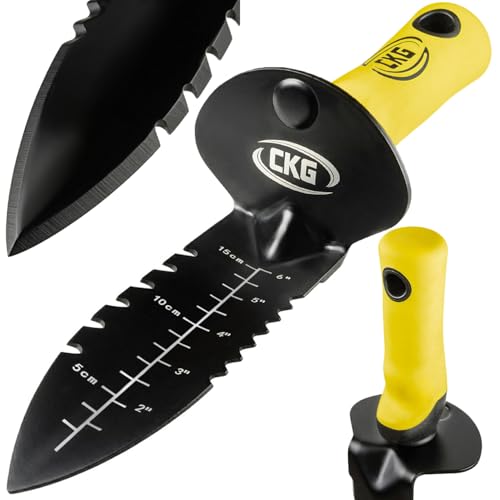
CKG Double Serrated Hand Digger
$29.99CKG publishes double serrated stainless edges that cut through roots, branches, rope and bags, a reinforced welded handle joint, a non-slip rubberised grip, 10.24 by 2.76 by 1.18 inches, and a sheath with a belt loop, at $29.99.
Best for: a first digger, or a spare for the car
Check price on Amazon
Root Slayer Heavy Duty Garden Trowel
$21.45Radius Garden publishes a powder-coated carbon steel blade with dozens of ripsaw serrations and a sharp inverted V cutting tip, on a non-latex thermoplastic handle with a reinforced polypropylene core, at $21.45.
Best for: garden soil, flower beds and permission hunts in soft ground
Check price on AmazonIntermediate: the reference digger, and a first full-size shovel
The Lesche Digging Tool and Sod Cutter with sheath is the tool most experienced detectorists in North America are carrying, and it has been for a long time. It is not cheap for a hand tool and the argument for it is simple: the blade cuts roots rather than pulling at them, the joint takes levering, and the steel is guaranteed not to bend.
The first full-size shovel is worth buying cheap. A shovel is a blunt instrument that lives in a car boot and gets abused, and the CKG at $59.99 does the same job as the name-brand equivalents for a fraction of the money while you work out whether you need one at all.
Lesche Digging Tool and Sod Cutter with sheath
$59.95Lesche publishes a 7 inch by 1.75 inch serrated, pre-sharpened blade on a 12 inch tool, with a knife edge for cutting sod, a blade mounted perpendicular to the handle for leverage, a heat-treated alloy steel blade guaranteed not to bend, and a belt holder, at $59.95.
Best for: cutting a clean plug in turf, season after season
Check price on Amazon
CKG Double Serrated Detecting Shovel
$59.99CKG publishes a heat-treated tempered steel blade with a sharpened edge and pointed tip, double serrated for cutting roots, on an ergonomic non-slip handle, at $59.99. It is roughly a third of the price of the name-brand equivalent.
Best for: a first full-size shovel for field and pasture
Check price on Amazon
Root Slayer Nomad Garden Spade
$46.69Radius Garden publishes a serrated blade with an inverted V cutting tip at roughly 70 percent the size of the full Root Slayer, on a fibreglass shaft with non-latex grips, at $46.69. A short spade draws far less attention than a long T-handle.
Best for: permission hunts where a long shovel would be unwelcome
Check price on AmazonExpert: the relic shovels
A full-size T-handle shovel is a relic hunting tool. It exists because targets on old sites are often twelve inches down in ground that has been compacted for a century, and because you are frequently digging in pasture or woodland rather than somebody's lawn. Lesche's Sampson pattern is the reference, hand made in the USA, and the choice between them is almost entirely about your height.
Weight is the other axis. CKG publishes a carbon-shafted version of its shovel at $71.99, and the argument for it is not performance, it is that a lighter shovel actually comes with you on the long walk rather than staying in the car.

Lesche Sampson Pro-Series T-Handle Shovel, 31 inch
$89.40Lesche publishes 31 inches overall, a 7.5 by 4 inch serrated and pre-sharpened blade, a weight of 2 lb 6 oz and hand manufacture in the USA, at $89.40. The 31 inch length suits most adults without needing to stoop.
Best for: relic hunting and deep targets in hard ground
Check price on Amazon
Lesche T-Handle Shovel, 36 inch double serrated
$99.80Lesche publishes 36 inches overall with a 29 inch shaft, a double serrated blade of roughly 7.3 by 4 inches, and a weight of 2 lb 9 oz, at $99.80. Five extra inches of shaft is the difference between standing and stooping all day.
Best for: taller users and all-day relic digging
Check price on Amazon
CKG Carbon Detecting Shovel
$71.99CKG publishes the same heat-treated serrated blade on a carbon handle it rates to support over 170 pounds, at $71.99. The weight saving is felt on the walk in rather than in the hole, which is where shovels get abandoned.
Best for: long walks between spots
Check price on Amazon
Lesche Mini Sampson T-Handle Shovel, 18 inch
$84.00Lesche publishes 18 inches overall with the same 7.5 by 4 inch serrated pre-sharpened blade, described as plenty of leverage in a low profile, at $84.00. It straps to a pack, which is the entire reason to own one.
Best for: hiking in to a site
Check price on AmazonWho should not buy this tier: Do not take a full-size T-handle shovel onto a mown park or a municipal green. You will not need 31 inches of blade for a target at four inches, it looks exactly like what people object to, and in many places it is what gets detecting banned. Do not buy the Lesche T-Handle Shovel, 36 inch double serrated if you are under about five foot eight, because the extra shaft becomes awkward rather than helpful. And nobody needs the Lesche Mini Sampson T-Handle Shovel, 18 inch unless they genuinely walk in to sites, since for the same money the 31 inch version does more.
How do the digging tools compare?
Serration is the column with no acceptable answer other than yes. Length is the column that decides comfort, and the sheath column decides whether the tool can be carried safely.
Every tool worth buying for detecting has a serrated cutting edge, and the published lengths run from an 18 inch packable T-handle up to 36 inches for taller users.
| Tool | Price | Published length | Serrated | Sheath included |
|---|---|---|---|---|
| Root Slayer Trowel | $21.45 | Hand tool | Yes, ripsaw teeth and V tip | No |
| CKG Double Serrated Hand Digger | $29.99 | 10.24 inch | Yes, double serrated | Yes, with belt loop |
| Root Slayer Nomad | $46.69 | About 70 percent of full size | Yes, with inverted V tip | No |
| Lesche Digging Tool | $59.95 | 12 inch overall, 7 inch blade | Yes, plus a knife edge | No |
| Lesche Digger and Sod Cutter | $59.95 | 7 inch blade, 1.75 inch wide | Yes, pre-sharpened | Yes, belt holder |
| CKG Double Serrated Shovel | $59.99 | Full size | Yes, double serrated | No |
| CKG Carbon Shovel | $71.99 | Full size, carbon shaft | Yes | No |
| Lesche Mini Sampson | $84.00 | 18 inch overall | Yes, pre-sharpened | No |
| Lesche Sampson Pro-Series | $89.40 | 31 inch overall, 2 lb 6 oz | Yes, pre-sharpened | No |
| Lesche T-Handle 36 inch | $99.80 | 36 inch overall, 2 lb 9 oz | Yes, double serrated | No |
Lengths, weights and blade dimensions are as published by each manufacturer. Where a listing does not state whether a sheath is supplied, the cell says no rather than assuming one is included.
How do you actually cut a plug that goes back?
- Pinpoint before you cut. Narrow the target down with the detector, then with a pinpointer, before the blade touches the ground. Every inch of guesswork here becomes an inch of extra hole, and the hole is what you will be judged on.
- Cut a three sided flap, not a circle. Push the serrated blade in vertically and cut three sides of a square, leaving the fourth as a hinge. Cut deep enough to go through the root mat in one pass rather than sawing at it, which is where a serrated edge earns its price.
- Fold the plug back on its hinge. Lever the flap up and lay it back on the grass still attached. The hinge keeps the roots connected and keeps the plug the right way round, which is why it knits back instead of dying.
- Work the loose soil on a cloth. Put the spoil onto a small cloth or into a pouch rather than onto the surrounding grass. Loose soil left on turf smothers it and is the visible sign somebody has been digging, long after the plug itself has healed.
- Backfill, replace the plug and tread it. Return the soil first, then the plug, then stand on it with your full weight to reseat the roots. Water it if the ground is dry and the weather is hot. Done properly the site looks untouched within a week.
Which tool for which ground?
Mown grass, sports fields and anything anybody looks at daily: a hand digger, always, and a plug rather than a hole. Garden beds and soft cultivated soil: a trowel is enough, and the Root Slayer Heavy Duty Garden Trowel is the cheapest thing here that will not bend. Pasture and ploughed fields: a full-size shovel is appropriate and nobody minds, because the ground is turned anyway.
Woodland and old house sites are where the serrated blade stops being a nicety. Roots are continuous rather than occasional, and a blade without teeth simply will not get through them, so you end up pulling at the plug and tearing it. This is also the ground where a pinpointer saves the most time, because the soil is full of iron and you can spend ten minutes on a target you would have located in thirty seconds. The pinpointer page covers that side.
Beaches are a separate problem entirely and the answer there is a sand scoop rather than any tool on this page, because a scoop sifts and a blade does not. Wear gloves for all of it. The gloves and knee pads page explains why the spoil rather than the tool is the hazard.
How we chose
We did not test any of these tools in person and no dig on this site is presented as ours. Blade dimensions, lengths, weights and materials are taken from each manufacturer listing and stated as such. Picks were chosen on three published criteria: a serrated cutting edge, a blade and handle joint that is built to be levered on, and whether a sheath is included, since these are genuinely sharp tools.
Sources
- Lesche Sampson Pro-Series, T-Handle 36 inch and Mini Sampson product listings
- Lesche Digging Tool and Sod Cutter product listing
- CKG hand digger, double serrated shovel and carbon shovel product listings
- Radius Garden Root Slayer trowel and Nomad product listings
Frequently asked questions
Why does a digging tool need serrations?
Because turf is held together by roots, and a plain edge pushes roots aside rather than cutting them. The result is a plug that tears instead of lifting cleanly, which does not go back and does not knit. Lesche publishes serrated teeth that slice through roots, weeds, vines and sod for exactly this reason, and every serious detecting tool copies the idea.
Do I need a shovel as well as a hand digger?
Only if you hunt ground that needs one. On mown grass and parks a hand digger is the correct tool and a shovel is actively unwelcome. On pasture, woodland and old house sites where good targets sit ten or twelve inches down in compacted soil, a T-handle shovel like the Lesche Sampson Pro-Series T-Handle Shovel, 31 inch turns a twenty minute recovery into a three minute one.
What length shovel should I buy?
Lesche publishes 31 inches overall on the Sampson and 36 inches on its longer T-handle. The 31 suits most adults. If you are over about six foot the extra shaft on the 36 saves your back over a long day, and if you walk a long way in to sites the 18 inch Mini Sampson straps to a pack and is the only one you will actually carry.
Is an expensive digger really better than a cheap one?
The differences are in the steel and the joint rather than the shape. Lesche publishes a heat-treated alloy blade guaranteed not to bend and a blade set perpendicular to the handle for prying. The CKG Double Serrated Hand Digger at $29.99 gives you double serrations and a sheath for about half the money and is genuinely good. The expensive one is bought for the joint surviving years of levering.
Should I carry the digger in a sheath?
Yes. These blades are sold pre-sharpened and serrated, and loose in a pouch or a car boot they are one of the more dangerous objects in the hobby. The Lesche Digging Tool and Sod Cutter with sheath includes a belt holder at the same price as the bare tool in this catalog, and the CKG Double Serrated Hand Digger includes a sheath with a belt loop, so there is no reason to go without.
Researched, not professional advice. This page is compiled from published specifications, manuals and owner-review consensus, not hands-on testing. Target ID numbers, depth figures and settings vary with soil chemistry, moisture, target size, depth, orientation and firmware version, so treat every figure here as a starting point and verify it against your own machine's manual and your own ground. As an Amazon Associate we earn from qualifying purchases.